Longform
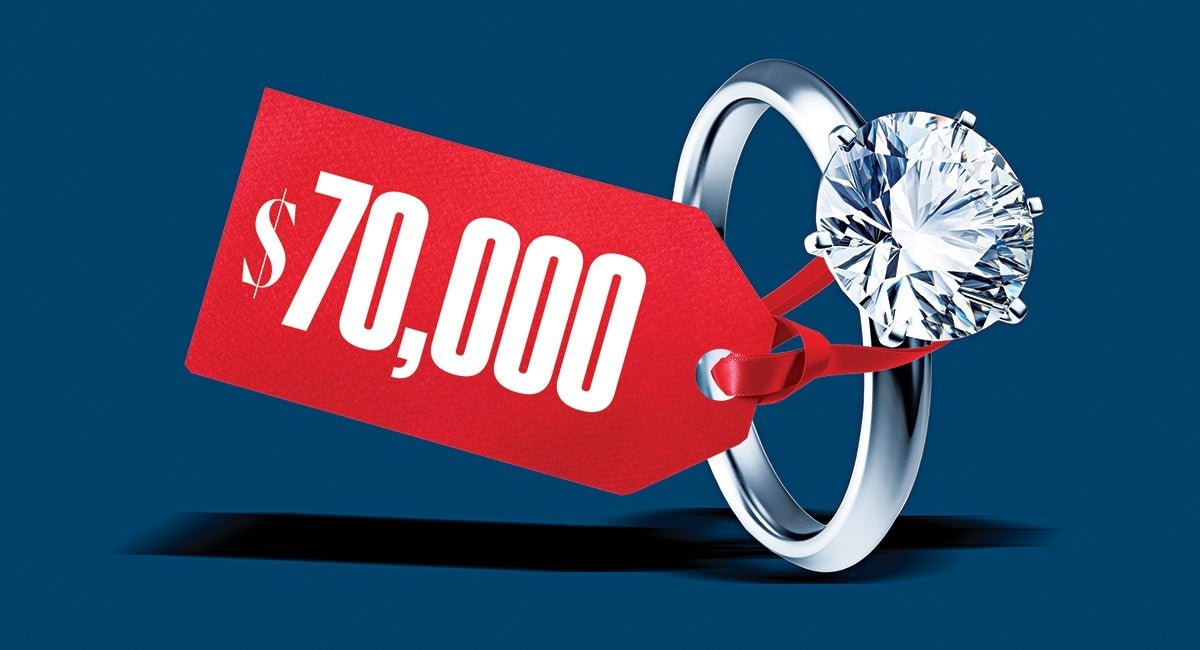
These days, a $7,000 lab-grown diamond is indistinguishable from a $70,000 mined one. And buyers aren’t just choosing the cheaper option—they’ve stopped caring about the difference altogether.
Get a compelling long read and must-have lifestyle tips in your inbox every Sunday morning — great with coffee!
Photo illustration by Benjamen Purvis / Getty Images
Photo illustration by Benjamen Purvis / Getty Images
The old script went like this: A lovestruck fellow would save his paycheck—for months, maybe years—to afford an engagement ring. Or a lucky heir would receive a rare bauble handed down across generations, the same one that glittered at a great-grandmother’s cocktail party.
These were natural diamonds: formed more than a hundred miles beneath the Earth’s surface under intense pressure and heat over billions of years, no two exactly alike, and eventually gleaming behind glass in jewelry cases. Romantic, rare, and—let’s be honest—ruthlessly expensive.
But when Spencer’s Mikaela Smith got engaged, she had something else in mind: a lab-grown diamond. Produced in a controlled setting with less labor and less environmental disruption, the stone has the same chemical and physical properties as a mined diamond, at just a fraction of the cost, and even the most experienced jeweler can’t tell the difference by sight alone.
A salon manager planning a June wedding at the Beauport Hotel in Gloucester, Smith says price was the primary driver for her and her fiancé, a high school English teacher. “We talked about it and just looked at the cost,” she says. “We could get a lot more for the value with a lab diamond.”
Smith worked with Wright Jewelry & Design Company in Hudson to customize a 2-carat, oval lab-grown diamond with side stones. The ring cost around $7,000, she says—far less than a comparable natural version. “I didn’t really care about the heirloom aspect,” Smith says. “What mattered was how it looked. And it was really cool to support a local business and get a custom design.”
A $7,000 stone that passes for a $70,000 one would have been unthinkable a decade ago. Today, it’s transforming the diamond industry, with even local jewelers at the highest end selling pieces made with lab-grown stones. “Lab-grown diamonds tend to resonate because they allow [buyers] to invest in something that’s still certified and has a quality design,” says Alyson Iarrusso, who runs New England–based Cove Fine Jewelry. “It’s really gone from ‘What can I afford?’ to ‘What do I want?’” Which, if you think about it, is a pretty big shift in a business that has always depended on the distance between those two questions.
For many Boston couples, lab-grown is more than just a budget-friendly choice: It’s a way to signal values—sustainability, ethical sourcing, smart spending. As Iarrusso puts it: “People buy lab-grown and are proud: They love the sustainability and the
accessibility, and nobody is hiding it.”
Woburn’s Melissa Gutierrez Cronin sought out a lab-grown stone from the South End’s Laura Preshong, known for eco-friendly rings. “I had ethical concerns related to mining,” Cronin says. “We also really like the store we bought it at: It’s a small business, women-owned, and they only sell ethically sourced diamonds. That’s so important to me.”
Cronin says she’s never been asked about her ring’s pedigree. In Boston, “Nobody asks you what kind of stone you have. Even if they did, I wouldn’t mind telling them it’s a lab-grown diamond.” A California native, she’s noticed something about her adopted city: “I think people here are very social-justice-oriented, which is nice.”
Westford’s Kayla Prange—whose 3-carat oval-cut ring from Andover’s Melanie Casey cost just over $5,000—feels similarly. “It’s so freeing to just let go of the whole idea of natural diamonds and get what makes more logical sense,” she says—both from a financial and sustainability perspective. Prange did have to explain the lab-grown concept to a few befuddled family members, but she wasn’t losing any sleep over it. “It’s no surprise that the majority of diamond mines are located in places where people have historically been severely exploited,” she says.
But here’s what the diamond industry would rather you not think too hard about: When a whole generation shrugs off the mythology that made diamonds valuable—the scarcity, the sacrifice, the heirloom permanence—the disruption isn’t the stone. It’s the shrug itself.
You’re not going to find a lab-grown diamond at an antique jewelry store, “but that doesn’t make them less meaningful.”
So the buyers are on board. But what about the people who actually sell the things? Hannah Florman, a custom jeweler with a Newbury Street boutique, sees customers of two schools of thought walk into her store. “I see a lot of couples who are in the health and science fields who are genuinely excited and interested in the lab-grown diamond concept, and also those who are eco-conscious,” she says.
On the other hand, she’s worked with Boston clients concerned about the heirloom quality of their purchase. Natural diamonds, she notes, tend to retain long-term value because they’re tied to the whims of mining and availability. Lab-grown diamonds, which can be produced readily as literal carbon copies, don’t command the same scarcity-driven prices. You’re not going to find a lab-grown diamond at an antique jewelry store, “but that doesn’t make them less meaningful,” Florman says. “It just means they’re better understood as deeply personal objects rather than investments.”
That distinction—personal object versus investment—is the fault line running through every jewelry store in the region.
Anto Aboyan, co-owner of Adamas Fine Jewelry, a luxury jeweler in Newton, admits he was initially skeptical of the trend. Over three decades in the business, Adamas has catered largely to deep-pocketed clients, and natural diamonds accounted for most of the business’s sales. “In the beginning, I really felt that it’s going to be negative. But it really hasn’t been a negative: This is another avenue of selling engagement rings to a certain consumer who generally couldn’t afford a $20,000, $30,000, or $40,000 diamond,” he says.
His sister and business partner, Veronica Sagherian, believes the trend is ushering in a more egalitarian era for the jewelry industry. “It’s basically opened up the opportunity for a younger, less affluent person to be able to afford something that would normally be only for a luxury market,” she says.
Natural stones continue to make up about 75 percent of their business, Aboyan estimates. The remaining 25 percent comes from buyers requesting lab-grown diamonds, often in larger sizes or elongated cuts. “If the consumer is asking for lab-grown, then we’ll be in the business of delivering lab-grown,” Aboyan says. “If the [demand] changes and 90 percent want lab, we’ll supply 90 percent lab.”
Boston Diamond Company, meanwhile, began carrying lab-grown diamonds about three years ago, but only after extensive vetting. Founder and CEO Stephanie Binder’s initial hesitation stemmed from quality concerns: Many lab grown diamonds are mass-produced and, despite strong certificate reports, at first weren’t up to the company’s standards. Certificates give baseline metrics like color, cut, clarity, and carat, the gemologist says. “But you can’t grade things like light, scintillation, brilliance, if it has haze or milky tones.”
Today, Binder estimates that about 90 percent of her clients choose lab-grown diamonds, and she believes they’ll be fully normalized within five years. In Boston, “We’re in a newer luxury market where consumers are no longer impressed by buzzwords,” she says. “They want to understand what they’re buying, how it performs, how it’s set, and how it will last over time.”
In other words, Boston’s jewelers say they haven’t been disrupted so much as recalibrated. The question, then, isn’t whether they can survive the lab-grown revolution; it’s whether the thing they used to sell—not the stone, but the story around it—can make it through.
Pull back a bit, and the bigger picture is hard to ignore. In 2015, lab-grown diamonds accounted for one percent of the overall market; in 2024, they accounted for 20 percent and have caused natural-stone prices to drop as demand shrinks. They’ve also upended a long-standing social ecosystem built on price, status, and meaning. In the past, “For a long time, the size of the diamond signaled what someone spent,” Iarrusso says. “Lab-grown diamonds are changing that equation.”
And while many of the Boston buyers in this story are proud, open, and even eager to sing their ring’s lab-grown status from the rooftops, not everyone is. One local jeweler who often works with clients in swanky enclaves like Palm Beach describes a quieter dynamic: buyers who choose lab-grown stones discreetly, especially in traditional or luxury-oriented circles. “I’ll hear, ‘I only want natural,’” says another local jeweler. “But then, privately, they’ll say, ‘I do want that. Can you create that for me? Nobody needs to know.’”
Then there are those who still gravitate toward natural diamonds—and don’t apologize for it. When Emily Baer was on the cusp of getting engaged, she says her fiancé, real estate agent Hans Nagrath, was firmly in the natural camp. “He was more in the heirloom, traditional, in-the-family-forever, work-of-art type mindset,” says Baer, a therapist and yoga instructor.
While Baer was initially indifferent to what type of stone her fiancé chose, she says her ring—a three-pronged teardrop stunner with a gold band from Boston Diamond Company—is perfect. “I trusted him with the design, and it’s beautiful,” she says. “It’s simple and timeless, and that’s where the heirloom piece ties into it.”
Beverly’s Noelle Guerin, meanwhile, went the other direction, eventually. When the hospitality and lifestyle marketing professional got married 23 years ago, she was proud to sport a natural diamond. But after it popped out of its setting on Thanksgiving last year and required replacement, she did some research: “I’d never considered lab until I did some digging and learned more about them: They’re ethically sourced, more affordable, and with great clarity,” she says.
Despite its lab-grown status, Guerin still considers her new ring an heirloom and plans to pass it on to her daughter someday. After all, it’s about the symbolism, not the stone. “To me, the ring signifies a beautiful marriage that I feel blessed to have and the journey to get there. That’s where the importance lies. I think there’s a misconception that lab-grown isn’t ‘real’ and therefore can’t be an heirloom,” she says.
And maybe that’s the real disruption—not that lab-grown diamonds exist, but that they’ve made the whole question of “real” beside the point. The scarcity is gone. The high cost is optional. The mythology has been politely yet firmly shrugged off. What’s left is just the ring on your finger and whatever story you decide it tells. For a lot of Bostonians, that’s turned out to be enough.
This article was first published in the print edition of the April 2026 issue, with the headline,“Can You Tell the Difference.”