The most dangerous moment in any war often comes when a fighter jet loses control, whether due to a malfunction, missile strike, or other causes, and crashes in enemy territory. In such situations, pilots are forced to eject and survive on hostile ground. Recent reports of an F-15E crash in Iran, where two pilots ejected, underline this risk. While one pilot has been rescued, the other remains missing, with survival hinging on the systems and training carried onboard.
For such high-risk scenarios, the United States Air Force has developed an advanced survival system, a combination of technology, strategy, and rigorous training designed to maximise a pilot’s chances of survival and rescue.
A SYSTEM BUILT ON SURVIVAL DOCTRINE
The system is not limited to a single kit but is a layered setup. It includes a survival kit attached beneath the ejection seat, a survival vest worn by the pilot, and additional gear such as helmets, radios, and weapons. Together, these support the four key principles of survival: Survival, Escape, Rescue, and Evasion (SERE).
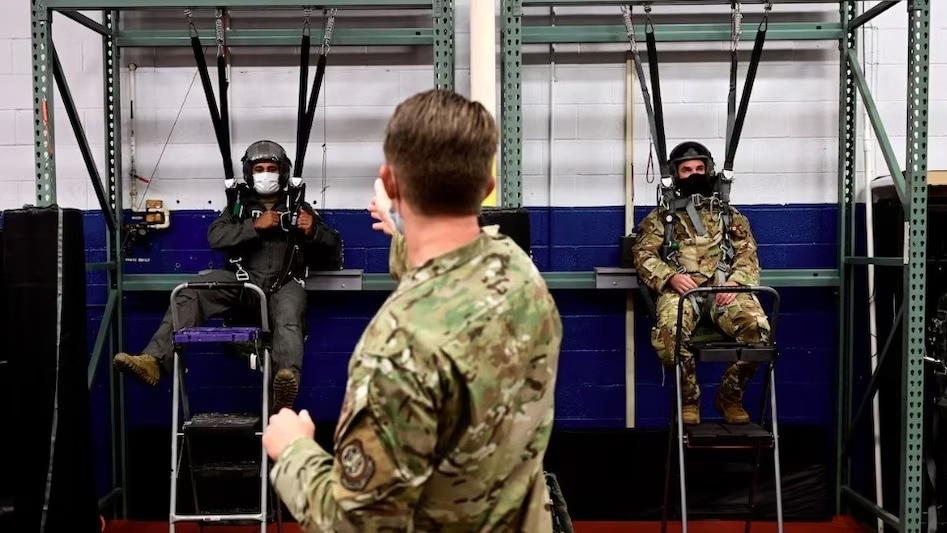
Pilots undergo specialised SERE training that prepares them to endure harsh conditions, evade enemy forces, resist capture, and ultimately reach rescue teams. The training emphasises adaptability and decision-making rather than dependence on equipment alone.
WHAT THE SURVIVAL KIT CONTAINS
The most critical component is the survival kit that deploys with the parachute during ejection. Once on the ground, it becomes the pilot’s lifeline. Communication and navigation tools are prioritised, survival radios enable contact with rescue teams, while compasses, signal mirrors, and GPS beacons help pilots determine and transmit their location.
These tools are especially crucial in hostile terrains such as mountains or forests. In the Iran case, the missing pilot is believed to be somewhere in the Zagros mountains, where both Iranian forces and potential rescue teams may be searching.
SIGNALLING FOR RESCUE
The kit includes a full range of signalling tools such as flares, smoke bombs, strobe lights, and glow sticks. These help pilots make their presence known to search aircraft or helicopters, especially in low-visibility conditions like dense forests or nighttime environments.
FOOD, WATER, AND ENDURANCE
Survival is not just about avoiding capture, it also involves sustaining oneself. The kit includes water packets, purification tablets, and high-energy emergency food packs designed to last between three to seven days. These lightweight supplies provide enough calories to maintain energy levels during extended survival periods.
MEDICAL SUPPORT IN CRISIS
Injuries are almost inevitable during ejection or crash landings. To address this, the kit contains first-aid supplies such as bandages and tourniquets. These allow pilots to stabilise themselves and control bleeding until professional medical help arrives.
PROTECTION AGAINST THE ELEMENTS
The kit is also equipped to handle extreme weather. Thermal blankets help retain body heat, ponchos provide protection from rain and wind, and fire-starting tools such as flints or matches enable warmth, light, and even cooking. These features ensure survival across diverse environments.
SPECIALISED GEAR FOR SEA LANDINGS
If a pilot ejects over water, the kit changes accordingly. It includes an inflatable life raft and “sea dye,” a chemical that spreads bright color in water to make the pilot visible from the air—critical for maritime rescue operations.
LAST RESORT: SELF-DEFENCE
While evasion remains the priority, pilots are also equipped for self-defence. Earlier limited to pistols, modern kits may include compact survival rifles that can be assembled when needed. However, their use is considered a last resort.
MODULAR AND ADAPTABLE SYSTEM
The US Air Force has made the system modular, allowing it to be tailored based on mission and terrain. Arctic missions include extra insulation, desert operations emphasise water and sun protection, and maritime missions come with sea-specific equipment. This flexibility enhances the system’s effectiveness across environments.
NOT ALONE, EVEN IN ENEMY TERRITORY
A pilot down in enemy territory may be isolated, but not helpless. With a combination of advanced equipment, survival training, and strategic preparation, the system significantly improves the chances of staying alive until rescue.
As the search for the missing pilot in Iran continues, global attention remains fixed on whether this system, and the training behind it, can once again prove its effectiveness in the harshest conditions.
– Ends
Inputs by Dhirendra Rai
Published By:
Akshat Trivedi
Published On:
Apr 4, 2026 06:38 IST
Tune In