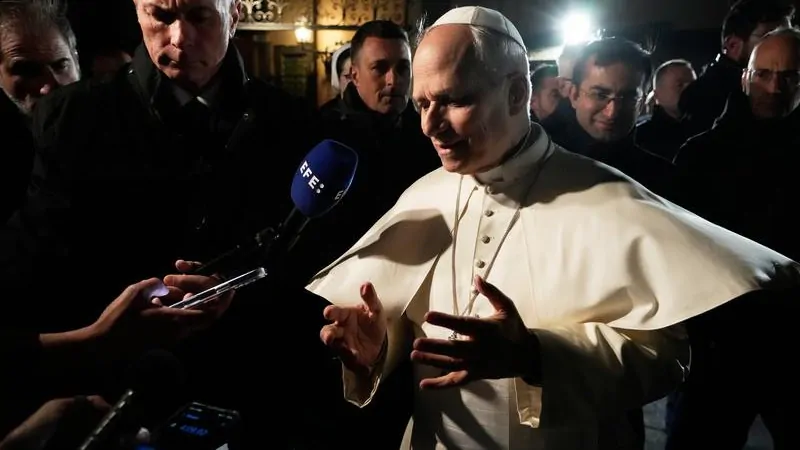
As Leo XIV approaches his first Easter as pope, a new era of American military might cloaked in religious righteousness is presenting him with a challenge: How to confront a vision of God being articulated by the Trump administration and its supporters that sounds radically different than the view of the Vatican, spiritual epicenter of the world’s largest Christian faith.
The administration’s depictions of a warlike God who picks sides have startled some in the Holy See, and they compelled Leo to counter them. He has done so repeatedly in recent weeks, most pointedly on Palm Sunday, saying God “does not listen to the prayers of those who wage war.”
He then quoted Isaiah 1:15: “Even though you make many prayers, I will not listen – your hands are full of blood.”
Sign up to The Nightly’s newsletters.
Get the first look at the digital newspaper, curated daily stories and breaking headlines delivered to your inbox.
By continuing you agree to our Terms and Privacy Policy.
On Thursday night, he spoke of blasphemy, then warned that “we tend to consider ourselves powerful when we dominate, victorious when we destroy our equals, great when we are feared.”
In a dramatic display on Good Friday, the 70-year-old pontiff will drive home his rebuttal further as he becomes the first pope in many years to carry a cross through all 14 Stations of the Cross during a traditional rite in and around Rome’s Colosseum. He said this week that he is seeking to set an example for how “Christ still suffers,” inviting “all people of good will … [to] be bearers of peace.”
Leo, now one month shy of his first anniversary of his selection to lead the world’s 1.4 billion Catholics, also appears to be answering an elemental theological question: What is the nature of God?
The Chicago-born pope, said one senior Vatican official, is not just aiming his words at the Trump administration, but at any and all who would seek to instrumentalize God for war.
“From the Nazi era onward, and even before then, ‘Gott Mit Uns’ [God with us] has always been a way to justify war, bloodshed and conflict by raising the conflict to a metaphysical, theological level, the victory of good over evil,” said the Rev. Antonio Spadaro, undersecretary of the Vatican’s Dicastery for Culture and Education. “What the pope was meaning to do is undermine this logic in which God with his heavenly army [align] with one side. … That’s a way of owning the divine.”
He added, “the pope is not only addressing the president of the United States – though this expression is becoming quite common in communications” from the administration.
Another senior Vatican official who spoke on the condition of anonymity to speak freely, described the Trump administration’s invocations of God as “an exploitation of faith.”
“The Pope made it very clear when he said you can’t invoke God to justify wars,” the official said. “It’s one thing if you pray like the Ukrainian soldiers do – to stop the Russians invading them – but it’s quite another if you invoke divine support while you go launching missiles at another country unprovoked.”
A third Vatican official, who also spoke on the condition of anonymity, said the pope, who has left more overt criticism of the administration to U.S. bishops, isn’t “opposing” the administration’s reading of God. Rather, Leo is expressing his own way of “living Christianity.”
That clearly differs from the Christianity being embraced by the administration.
US President Donald Trump. Credit: Alex Brandon/Sipa USA
In the lead-up to the war, Trump ally Franklin Graham, preaching at a Pentagon prayer service in December, said “we think about God as a god of love. But did you know that God also hates? Do you know that God also is a god of war?”
At a recent news conference, Secretary of Defense Pete Hegseth asked God to give U.S. troops fighting Iran “overwhelming violence of action against those who deserve no mercy.”
On March 6, Christian leaders – in an image that flew around the globe – laid hands on President Donald Trump and talked of God “lifting up the arms of our president” – a president who had just launched a preemptive war.
And on Wednesday, Paula White-Cain, a spiritual adviser to Trump, appeared to compare the president to Jesus and heralded a divine hand in his endeavors, drawing outrage and accusations of heresy from some faithful.
“Because he was victorious, you are victorious,” White-Cain said at a White House Easter lunch. “And I believe that the Lord said to tell you this: Because of his victory, you will be victorious in all you put your hands to.”
Leo is staying in his wheelhouse – what is the job of a pope if not to connect the faithful to God? But his increasingly pointed emphasis has exposed him to criticism. Like his predecessor, Pope Francis, who died nearly one year ago, Leo is being called out openly by conservative critics in the United States for allegedly misinterpreting the Bible.
Defense Secretary Pete Hegseth. Credit: ERIC LEE/NYT
“To say that God is against war per se is flat out false,” declared the conservative American pundit Allie Beth Stuckey on X.
Responding to Leo’s Palm Sunday message, conservative commentator Buzz Patterson wrote: “This isn’t Biblical.”
So what does scripture really say of war, and how have past popes dealt with the question?
In short, is Leo right? The answer, scholars say, is nuanced.
Popes in the Middle Ages called for crusades to reclaim the Holy Land, while Julius II, the “warrior pope” of the Renaissance, led military campaigns to expand the territory and power of the Papal States.
Modern popes almost universally have rejected the invocation of God for war. Yet the Vatican hasn’t always seemed to condemn all wars equally, and has coupled opposition with militant neutrality, some would say to a fault as when Pius XII refused to directly confront the march of the Nazis across Europe.
John Paul II initially displayed a measure of understanding over the U.S. invasion of Afghanistan after the attacks of Sept. 11, 2001, citing the “right to defend oneself against terrorism.” But he said only terrorists, and not nations, should pay the price, and called for a quick end to military operations. He also mounted strong behind-the-scenes opposition to the 2003 invasion of Iraq, famously declaring earlier that year: “No to war!”
Pope Francis, also a wartime pope, called repeatedly for peace in Ukraine and Gaza but at times he showed sympathy to both sides. He acknowledged Ukraine’s right to defend itself as “an expression of love toward one’s homeland” and also sympathized with Moscow, suggesting that “NATO barking at Russia’s doors” might have provoked the invasion in the first place.
Monsignor Charles Pope, a Washington, D.C., pastor and Catholic news columnist who has led worship groups at the White House and in Congress, said that Hegseth praying that enemies “deserve no mercy” and Graham declaring “God also hates” were misuses of scripture. Christianity, he said, calls for Old Testament phrases to be read in light of New Testament teachings, and both to be read with the recognition that language has changed over millennia.
There are also differences in how Catholics and Protestants understand scripture. Old Testament passages about “hate or wrath” are seen as archaic. “God cannot hate in the literal sense of the word,” Pope said.
The Vatican has long relied on the “just war” theory which has some roots in the teachings of St. Augustine and St. Thomas Aquinas, in which war must be avoided at all costs but can be justified if certain moral criteria are met. But even if a war is considered just, Pope said, that doesn’t mean God blesses it.
“If war cannot be avoided, it is due to human sinfulness and we should never call in God as a reason to go to war,” he said.
Yet Pope noted that Catholicism does acknowledge that war is “sometimes a sad necessity,” and said “it’s too extreme or unnuanced to say God “doesn’t listen to the prayers” of those who wage war – something Leo said. “If so, does this apply to all soldiers, military leaders, police chiefs and police officers?” Pope said.
Archbishop Timothy Broglio, who leads the Archdiocese for the Military Services USA, said human beings have always faced the “temptation to see some sort of divine favor to one’s endeavors” – a tendency he called problematic.
“Catholics in general would resist a temptation to use scripture to justify actions which are fundamentally political or defensive,” Broglio said. “That’s not to say there is not an objective right and wrong, but we’d return to just war theory, which in this case says defense is one thing – offense is quite another.”
Even if violence meets the just war theory standard, Broglio said, “I’d never take it beyond that. Just war theory would justify the actions in defense of a country, or responding to defending allies. I would hesitate to say God takes sides in the infighting of his children.”
The Rev. Kenneth Himes, an author and professor at Boston College focusing on theology and ethics, including around war, said he sees Leo and other leaders, including Jerusalem Cardinal Pierbattista Pizzaballa, clearly pushing back on Hegseth’s rhetoric.
Pizzaballa in recent weeks has warned against people exploiting and manipulating the name of God for purposes of war.
“The abuse and manipulation of God’s name to justify this and any other war is the gravest sin we can commit at this time,” Pizzaballa said at a webinar on the war in the Middle East. “War is first and foremost political and has very material interests, like most wars. We must do everything we can to leave no room for this pseudo-religious language.”
Boorstein reported from Washington. Stefano Pitrelli contributed this report.
© 2026 , The Washington Post