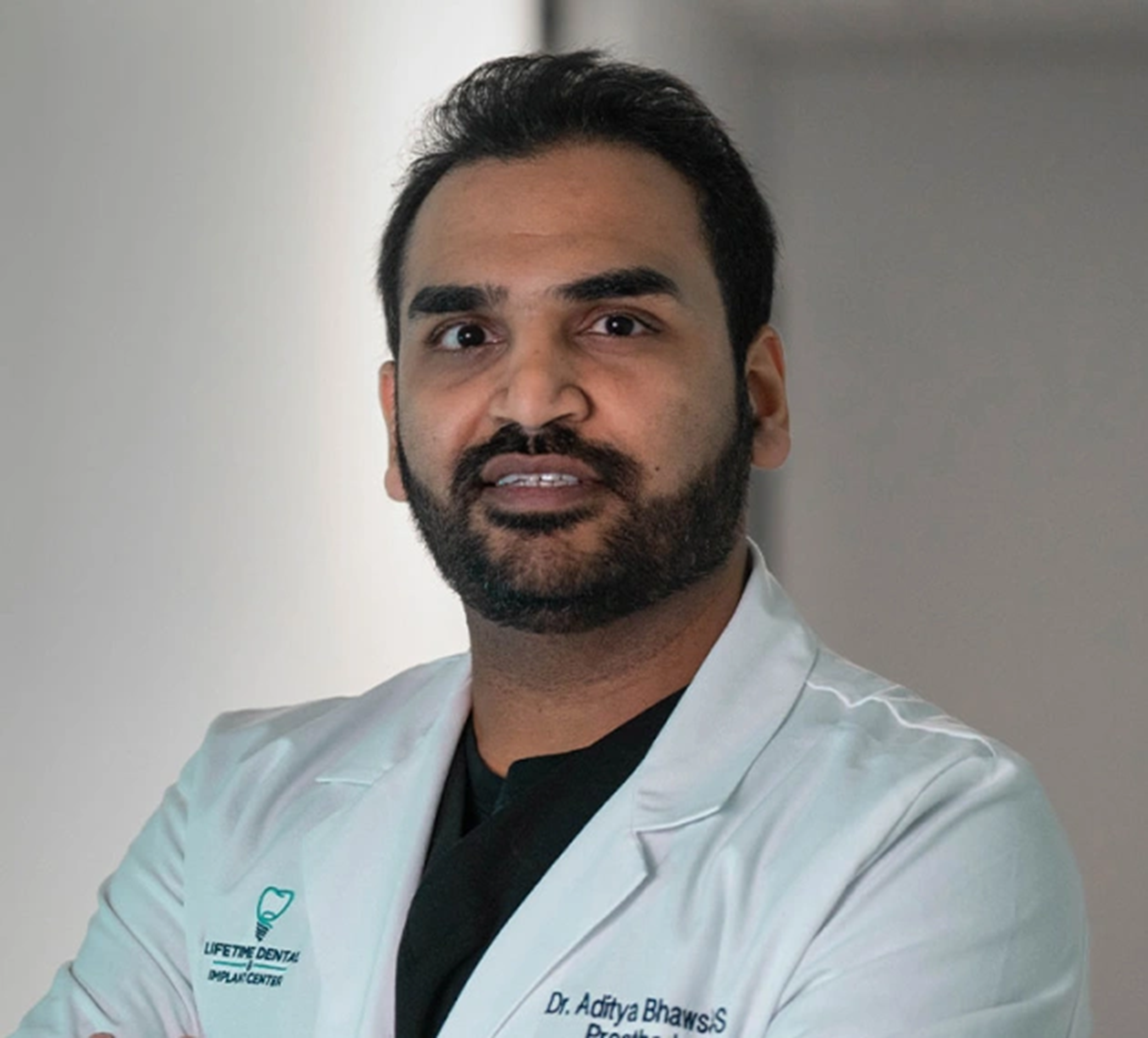
A patient walks into a Houston-area clinic missing every tooth in an arch. Twelve hours later, that same patient leaves with a full set of fixed provisional teeth placed with sub-millimeter accuracy. The clinician behind that turnaround is Dr. Aditya Bhawsar. He is a Surgically trained prosthodontist whose command of photogrammetry, three-dimensional printing, and guided surgical protocols has compressed months of treatment into a single visit.
Full-arch implant rehabilitation is the process of anchoring a full row of prosthetic teeth onto four to six titanium posts placed through surgery. It remains one of the most demanding procedures in restorative dentistry. A passive fit across the entire arch demands accuracy at every stage, from capturing implant positions to milling the final prosthesis. Dr. Bhawsar earned his Certificate in Prosthodontics and Master of Dental Sciences through a dual-degree program at Rutgers School of Dental Medicine. He then completed an Implant Fellowship at Loma Linda University. He recognized early that conventional analog methods could not keep pace with what patients needed.
The Precision Problem, and How Photogrammetry Solved It
Traditional impression techniques rely on polyvinyl siloxane materials and open-tray copings. The process is prone to distortion across fully edentulous arches where stable landmarks are scarce. Even intraoral scanners, despite years of refinement, suffer from stitching errors that grow worse over the span of a full arch. Photogrammetry offered a different logic entirely. It uses calibrated photographs and visual triangulation to record the three-dimensional position of each implant body, rather than building a surface map through sequential scans stitched by software.
“When we adopted photogrammetry into our full-arch cases, the marginal discrepancy in our restorations dropped to a range that analog workflows could not match,” Dr. Bhawsar explained. “A prosthesis that does not seat passively generates oblique forces on the implants. Over time, those forces threaten osseointegration and long-term survival.”
Dr. Bhawsar now applies photogrammetric verification as standard protocol at Lifetime Dental and Implant Center, the specialty practice he co-founded in greater Houston. The result has been fewer remakes, less chair time per case, and prosthetic frameworks that seat on the first try. Patients who would otherwise endure multiple adjustment visits now see their cases completed far sooner.
Same-Day Teeth Through Guided Surgery and Three-Dimensional Printing
Speed without accuracy is reckless. Accuracy without speed is a burden to patients who are edentulous and functionally impaired. Dr. Bhawsar’s clinical model resolves that tension through guided surgery paired with rapid prototyping. Cone-beam computed tomography data is merged with photogrammetric records to produce a virtual surgical plan. A printed surgical guide then directs the precise angulation, depth, and position of each implant. The guide removes much of the manual variability that defined previous generations of implant placement.
Once the implants are seated, a provisional full-arch prosthesis, often printed or milled chairside that same morning, is delivered under immediate load protocol. The patient regains function, speech, and appearance in one appointment. The global market for dental implant procedures is expected to reach 8.37 billion dollars by 2031, driven in large part by patient demand for immediate-function protocols like the ones Dr. Bhawsar performs daily.
Remote Anchorage and the Cases Other Clinicians Decline
Where Dr. Bhawsar’s training separates him from the broader field is in his ability to accept patients other specialists have turned away. Severe maxillary bone loss can make conventional implant placement impossible. Remote anchorage offers a solution. It involves placing implants into structures outside the alveolar ridge, such as the zygomatic bone, pterygoid plates, or nasal floor, bypassing the need for grafting and months of healing. Few prosthodontists in the United States perform these procedures because the technique demands deep knowledge of craniofacial anatomy and carries a steep learning curve.
Dr. Bhawsar’s fellowship at Loma Linda, paired with advanced surgical training, equipped him to place zygomatic and pterygoid implants and deliver same-day prostheses on those fixtures. His Fellowship with the International Congress of Oral Implantologists and Associate Fellowship with the American Academy of Implant Dentistry confirm his standing within a small group of clinicians credentialed at this tier. He has contributed to scholarly literature and presented at national and international meetings, including the Indian Dental Conference.
“Patients with severe bone loss deserve fixed teeth, not another set of removable dentures,” Dr. Bhawsar said. “Remote anchorage gives us a predictable path to full-arch restoration without subjecting patients to grafting procedures that add six to twelve months before a single implant can be placed.”
Across the Houston region and the wider implant community, practitioners are watching the convergence of photogrammetry, guided surgery, and three-dimensional printing compress timelines and raise accuracy standards. Dr. Bhawsar operates at the leading edge of that movement, applying a fully connected workflow that bridges surgical planning and prosthetic delivery with a precision that older methods never achieved.