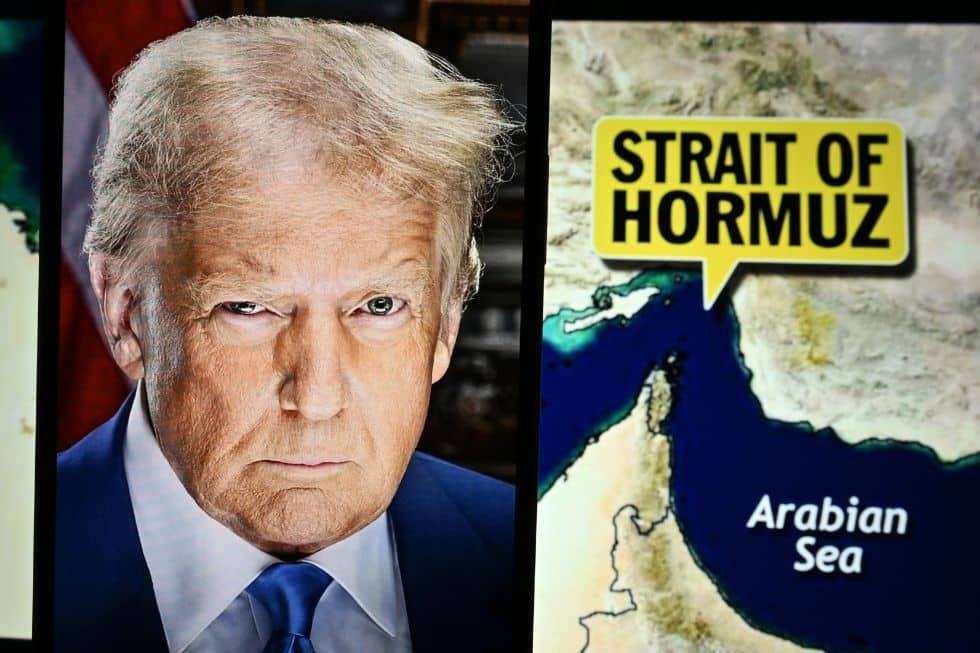
US President Donald Trump’s decision to stretch his ultimatum over the Strait of Hormuz from 48 hours to five days was not a sign that the crisis has suddenly come under control. It is a sign that last week’s threat has run into reality.
The White House had warned that Iranian power plants and energy facilities could be hit if the Strait of Hormuz was not reopened. But by Monday, Trump had paused those strikes after what he called “productive” contacts, even as Iran denied any talks were taking place. Reuters also reported that the pause appears to apply only to energy sites, not to wider military targets. That is not a coherent strategy. It is a tactical retreat from one especially dangerous form of escalation.
The limits of military pressure and the tactical retreat
The most telling detail is why Trump pulled back. Reuters also reported that Gulf Arab states had warned Washington that strikes on Iranian power infrastructure could trigger severe retaliation against energy assets across the Gulf. In other words, the threat to hit power plants did not promise control; it threatened a wider regional breakdown. That matters because it changes how we should understand the original ultimatum. It was not a credible plan for reopening Hormuz. It was a way of shifting pressure away from a military bottleneck and onto civilian systems. When a government cannot quickly solve the problem in the water, it starts looking for leverage on land. Too often, that means ordinary life becomes the battlefield.
That shift should worry anyone who still believes strategy and restraint belong in the same sentence. The Strait of Hormuz remains largely closed, oil is still above $100, and countries like Japan are drawing down reserves because the disruption has not ended.
The five-day extension: buying time, not solutions
The five-day extension did not reopen the channel. It bought time in the markets and perhaps time for mediation, but it did not change the underlying fact that the US has not found a workable way to force the strait open without risking broader escalation. A threat against civilian infrastructure may sound forceful on television, but it does not move mines, widen shipping lanes or create political consent where none exists.
The military problem here is more stubborn than Trump’s rhetoric suggests. Hormuz is one of the world’s most critical oil chokepoints, with about 20 million barrels per day of crude and oil products moving through it in 2025, or roughly a quarter of global seaborne oil trade. There are only a limited number of ways around it. That geography is why even some of Washington’s allies have resisted being dragged into a rush to “unblock” it on Trump’s terms.
Allies’ reservations, geographic reality and humanitarian stakes
According to Reuters, several allies were unenthusiastic about providing military support, and some conditioned any role on de-escalation rather than war expansion. The problem is not a lack of threats; it is that threats do not solve geography.
This is also where the legal danger becomes impossible to ignore. International humanitarian law prohibits attacking or rendering useless objects indispensable to the survival of the civilian population. That principle matters everywhere, but it carries special weight in the Gulf, where electricity and desalination are not luxuries. They are part of how millions of people get water and keep hospitals, homes and public life functioning.
The EU’s leaders recognized the danger last week when they called for a moratorium on strikes against energy and water facilities in the Middle East. That call was not a diplomatic decoration. It was an acknowledgment that this war is edging toward attacks whose civilian consequences cannot be brushed aside as collateral.
Trump’s defenders will argue that the threat worked because it created diplomatic space. Maybe. But even that claim looks thin. Iran publicly denied the existence of direct talks, and Reuters reported that Tehran has hardened its negotiating position and is demanding far more than Washington appears willing to accept. If so, the five-day pause is less a breakthrough than a holding pattern. It may steady markets for a few hours and allow intermediaries to shuttle messages, but it does not settle the central issue. A bluff against power infrastructure is not the same as a maritime solution. It is an attempt to compensate for strategic frustration by raising the civilian stakes.
The drift toward civilian targets and the erosion of strategy
That is what makes this episode larger than one deadline. The real story is not simply that Trump changed 48 hours to five days. It is that the war’s logic has drifted. The pressure is no longer confined to ships, missiles and naval patrols. It is being pushed outward, toward grids, pumps, ports and desalination plants, as if civilian vulnerability can succeed where military coercion has stalled. That is a familiar pattern in modern wars.
When leaders cannot deliver the outcome they promised, they do not always scale back. Sometimes they widen the pain until something breaks. The danger now is that what breaks first will not be the blockade. It will be the line separating war from the deliberate degradation of civilian life.
If the Trump administration were serious about reopening Hormuz, it would be investing its political capital in de-escalation, coalition diplomacy and a realistic assessment of what force can and cannot do in a narrow, mined, heavily exposed waterway. Instead, it flirted with the idea of turning energy and possibly water systems into bargaining chips, then stepped back only after Gulf allies warned that the costs could spiral beyond control. That is not strength; it is an admission that the original approach has failed. And once a war begins leaning on the infrastructure civilians need to live, it is usually a sign not that victory is near, but that strategy is running out.
[Kaitlyn Diana edited this piece.]
The views expressed in this article are the author’s own and do not necessarily reflect Fair Observer’s editorial policy.