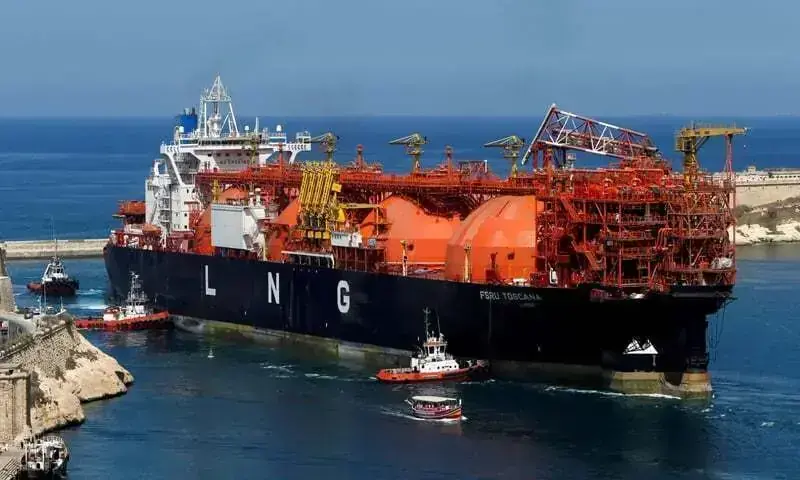
ISLAMABAD: Government officials said during a public hearing on Tuesday that liquefied natural gas (LNG) supplies were under force majeure and not available for power generation.
Force majeure is a clause included in contracts that allows a party to be excused from its obligations due to circumstances that are beyond its control. The officials’ revelation during the National Electric Power Regulatory Authority (Nepra) hearing thus means that LNG supplies were unavailable due to circumstances that were beyond the relevant parties’ control.
Responding to questions, Central Power Purchasing Agency (CCPA) Chief Executive Officer Rehan Akhtar said LNG supplies were currently under force majeure, but he assured that coal supplies — another source for power generation — through imports were not facing any problems as they mostly came from South Africa and Indonesia, and were unaffected by disruptions in the Middle East. LNG-based power plants have a generation capacity of more than 4,500 megawatts.
An almost a month-long ongoing US-Israeli war on Iran has spilled over to draw in Gulf countries and subsequently resulted in a global fuel crunch. The situation is worsened by traffic disruptions in the Strait of Hormuz — a corridor that had been the route for 20 per cent of global LNG and a quarter of seaborne oil until the war began.
The war has also led to production stoppages, notably by Qatar, which stopped all operations at its LNG facilities on March 2 and declared force majeure two days later, halting supply from a source that accounts for about 20pc of global LNG.
Officials at the Nepra hearing said consumers would be encouraged through a pricing package to better utilise cheaper electricity available during the daytime.
“The cheaper electricity available during daytime will be utilised in a better way, and measures would be taken after taking people into confidence over whatever the situation is,” said Naveed Qaiser, the chief financial officer of the Power Planning and Monitoring Company (PPMC), as he testified at the hearing.
He assured that fuel cost adjustments would not go up by Rs8-10 per unit, saying that the government was working on a daily basis and at almost every level to ensure that consumers did not face any problems.
“Things are under control at the moment, and no big shock is forseen”, he said, adding the government was also working on a tariff package to encourage better utilisation of electricity during the daytime when solar power generation was also possible.
For his part, Akhtar said LNG-based power plants, though among the most efficient, could not be run on domestic gas through diversion from older plants on dedicated gas fields.
Responding to a question, the CPPA chief said there were some problems regarding coal transportation for Sahiwal and Jamshoro power plants. He said the Power Division, CPPA and other relevant government agencies were working on a daily basis to ensure that coal inventories did not deteriorate and to run power plants at maximum capacity.
He also assured worried industrial consumers that electricity rates for April would remain unchanged as a Rs1.64 per unit positive fuel cost adjustment (FCA) for February consumption would replace an existing Rs1.63 per unit positive FCA for January consumption that was charged in March bills.
Akhtar also said that power supply from the national grid to K-Electric (KE) was beneficial for both Karachi and other consumers.
“If KE had not been provided any electricity from the national grid, an overall increase of Rs1.05/kWh in the FCA and an increase of Rs3.03/kWh in the capacity purchase price would have resulted for the consumers. Total cost would then have been Rs4.08/kWh for February”, he said. Not only this, the quarterly tariff adjustment against February consumption was expected to be Rs2.79 per unit lower, thus providing a net relief going forward.
He also said circular debt would not exceed Rs1.69tr at the close of the current fiscal year, notwithstanding seasonal fluctuations and subsidy payments from the budget.
PPPMC CFO Naveed Qaiser said that circular debt in January stood at Rs1.7tr compared to Rs2.4tr in January last year, which was a reduction of about Rs780bn.
For their part, industrial representatives asked Nepra to recommend to the government the formulation of a fixed and all inclusive industrial tariff regime for export and import substitution insutries to avoid uncertainties, and such a tariff including FCA, quarterly tariff adjustment, debt servicing surcharge and other charges be fixed within eight to nine cents per unit, with a hard ceiling of nine cents for at least five years to ensure international competitiveness.
Officials reported that the government had successfully absorbed significant cost pressures to ensure that the benefits of tariff adjustments were passed on to the public. Despite global fuel price volatility, cumulative relief amounting to Rs46.56bn had been provided to consumers during the first eight months of FY2025–26 (July–February), resulting in an overall reduction of Rs0.71/kWh at the consumer-end tariff, they said.
Industrial consumers, meanwhile, witnessed a substantial decline, with pre-tax tariffs falling from Rs49.19/unit (18 cents) in March 2024 to Rs34.75/unit (12 cents) in March 2026 — a reduction of Rs14.44/unit, it was reported.
The hearing was told that the incremental tariff package had resulted in 25 per cent growth in electricity consumption in the industrial sector and 7pc growth in the agriculture sector. More than 43pc of industrial consumers and 35pc of agriculture consumers benefited from the package, with 203,367 consumers availing the incentive package for higher consumption at lower rates.