There is no dialogue, only voices.
It has been eighty years since the end of World War II, and as a form of national Remembrance we hear from the voices of more than 60 Prisoners of War in Wildbear Entertainment’s latest production, Under a Bamboo Sky.
The film is not an easy one to watch, and it isn’t meant to be. Using archival material and (new) location footage, director Serge Ou not only wanted to acknowledge, recognise and honour the servicemen of the time, but also to bring the reality of what they endured home to audiences. It goes far beyond the category of a documentary, as the film is driven by a testimony-based narrative. Voiceovers are layered over archival footage from around the world.
Structurally, the story unfolds in a linear progression, but the audience is immersed more in the emotional journey of the prisoners as we hear their first-person accounts. As historical writer Michael Cove explains, his script methodology was to find key themes drawn from thousands of pages of interview transcripts. Using these, the film avoids traditional dialogue, relying instead on first-person testimonies to tell the story.
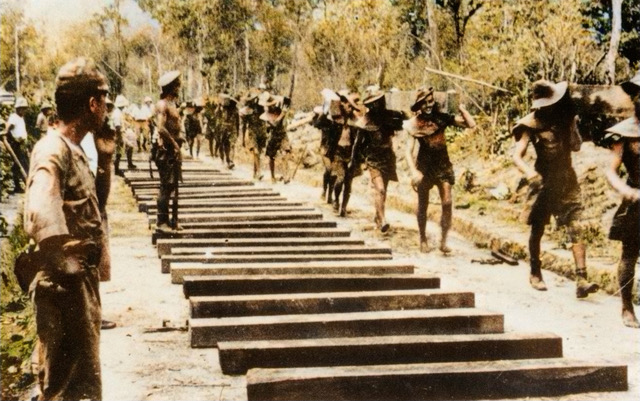
The testimonies were recorded between 1999 and 2004, around 50 years after their liberation. The men were aged between 18 and 32 at the time of their capture. Visuals such as portraits of the men themselves, originally taken when they became servicemen, are brought to life using new technology. Black and white footage was colourised to make it feel familiar and real to a modern audience.
For myself, the skilful making of this production made it an entirely visceral experience; the film sets a tone and emotion, as well as telling history. There are no attempts to polish or make things ‘politically correct’; rather, it presents the experience exactly as it was lived by the teller. By the end of the film, I felt rather emotionally exhausted but in a way that felt necessary and meaningful.
The authenticity forces you to confront the brutal realities of war, survival, and what it means to try to hold onto humanity; as quoted by one of the speakers, ‘to lose hope was to die’. What also stayed with me was how, despite everything, the prisoners could still find moments of humour. I distinctly remember the subtle Aussie humour when one voiceover described how there were many “Mickey Mouses, Ned Kellys and Don Bradmans” that signed the documents they were forced to complete.
The depiction of life in Changi prison as being a home away from home, where prisoners would have fragments of normality, such as organising small concerts is where the film starts and ends. Firstly, the surrender, and the move into Changi. They had little to do, waiting for the end, so the idea of a work party going to Thailand, at first, sounded great.
We follow the prisoners that took the train to Thailand to work on the Thai/Burma railway. Over 2,700 Australian Prisoners of War died during its construction – conditions were inhumane, there was starvation, bashings and overwork, along with cholera, malaria, dysentery and the like. It lasted 18 months.
The slave labour didn’t end there. After the railway, prisoners were loaded onto ships bound for Japan to work in coal mines. 1,800 died at sea en route to Japan, and many more died in the hard labour of the coal mines. What stood out throughout all this suffering was the importance of mateship. Survival wasn’t just physical; it was also emotional, and there was a uniquely strong sense of camaraderie among the Australians: Aussies always had someone next to them when they died, whereas ‘the Brits’ didn’t.
Life continued. Clothing was minimal, food scarce, and survival depended on ingenuity and solidarity. Makeshift hospitals, crude tools used for amputations, and improvised medical techniques like bamboo IV lines became lifelines. They remember the flash of the atomic bomb and saw the anvil forming. Then finally on Nov 5th, 1944, parachutes dropped trunks filled with Hersheys chocolate and Campbells soup.
To completely honour their entire story, I was glad the filmmakers didn’t end the story there. In total it was 3.5 years as a prisoner of war, and 5 years out of the country.
Their return home was marked by isolation, lack of understanding, and inadequate support. Many survivors struggled deeply—some took their own lives, others were institutionalised, and a significant number lived with permanent psychological trauma. As one of the men stated, he remained a “prisoner all his life”. And for that, this is a must watch film for all.
Reviewed by Rebecca Wu
Rating 5 out of 5
Official Trailer: Under A Bamboo Sky – Official Page
Under a Bamboo Sky opens at the Capri Cinema Goodwood on 2 April and other cinemas later.
Distrutor: WildBear Entertainment
A heavy and necessary film.