The set restart rule was supposed to decongest rugby league by greasing up the ruck and turfing out the sloppy floppers.
But after striking a happy medium last year that culminated in the most memorable finals series in recent memory, the rule has become such a scourge again it’ll soon be against the law to tackle.
If Peter V’Landys resents the AFL so much, why’s he trying to usurp the game as winter’s newest form of reiki basketball?
Sign up to The Nightly’s newsletters.
Get the first look at the digital newspaper, curated daily stories and breaking headlines delivered to your inbox.
By continuing you agree to our Terms and Privacy Policy.
Yes, every footy fan appreciates the occasional game of end-to-end jersey-grabbing and even the odd thrashing.
And yes, who doesn’t love footy when it’s slick and sexy, or even just shaming slovenly props for having a spell in the ruck?
Everyone agrees unshackled footy is good footy- but not when the scorelines are blowing out because you can drive a b-double through the defensive line.
And if that’s not enough, surely when a sketch merchant like Cam Munster is pleading for “clarity” it’s sufficient evidence the project has veered violently off course.
Studies conducted by esteemed stats bible The Rugby League Eye Test reveal set restarts have soared to a horrendous average of 11.5 per game in 2026, up from 6.4 last season.
Now polluting stadiums with a persistent ding ding for every infringement, set restarts have multiplied in such numbers that disoriented fans no longer know if they’re at the footy or church.
This has included the Gold Coast Titans being nabbed twice in the first set of Sunday’s game against the Cowboys and the Tigers being awarded so many six-agains against Souths on Saturday night there’s rumours Cam Murray is still on the field tackling to clear the backlog.
But despite this objective mockery, chairman V’Landys has predictably backed the rule and blamed the players for a “lack of discipline”.
And while admittedly the increase can be partially attributed to naughty boys in the tackle – and the rule change allowing set restarts up to the 40m line rather than 20m – the majority of the blame for this fiasco can be footed on thought bubbles.
With studies also revealing set restarts are awarded predominantly at the start of the game – the Storm-Broncos game had 13 in the first half and none after 51 minutes – six-agains feel like an arbitrary edict piped down from a front office driven by their crucial realtime rugby league data, aka ball-in-play stats from Super Rugby.
Add history’s inclination for the rule being mysteriously parked for State of Origin and finals every year, and it all amounts to set restarts being as predictable as a frightened racehorse.
Where does the insanity end?
The six again rule has baffled NRL fans since being introduced during COVID, a time when rule makers were treating sport like it was in international waters.
But while launched with the best of intentions, the NRL administration was so obsessed with speed and fatigue some mistook their messaging for an RTA advert.
And while everyone was excited to see the play-the-ball get a laxative after years controlled under the Melbourne Storm’s spinal practionership, nobody could’ve forecasted the rule that was designed to stop blowing the pea out of the whistle would eventually start blowing the speakers out of the PA system.
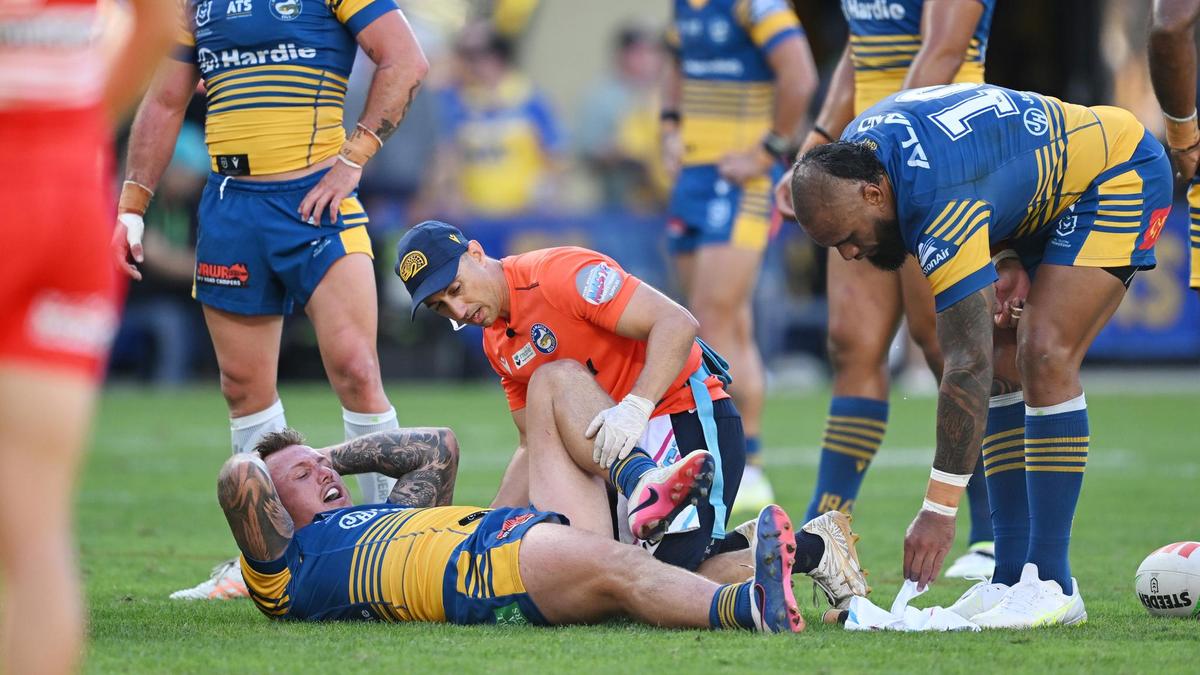
J’maine Hopgood suffered an ACL injury against the Dragons. Credit: Supplied
Now polluting stadiums with a persistent “ding ding” for every infringement, set restarts have multiplied in such numbers that disoriented fans no longer know if they’re at the footy or church.
But being an administration as stubborn as it is Trumpian, there’s no way V’Landys and co will walk it back any time soon.
That leaves only one avenue to reform this bastard rule: an utter disaster.
Thus far the most haunting observation on the set restart controversy has belonged to Jason Ryles, with the Eels coach delivering a philosophical light globe after losing lock J’maine Hopgood to an ugly ACL injury sustained in a hip-drop by Ryan Couchman.
“Those tackles, 99.99999 per cent of the time the boys don’t mean it, so it’s not intentional” Ryles mused.
“But unfortunately you keep throwing fatigue into the game and you keep making them (more tired) they happen.
Never mind the irony of a coach begging for more penalties, Ryles revealed the gravest failure of this rule won’t be transforming the game in to OzTag or starving a defending team of the football for an entire eighty minutes.
It will be a spate of serious injuries involving unfortunate battlers out on their feet because they’ve made more tackles in a half of footy than Dallas Johnson and Nathan Hindmarsh combined.
Players drained from repeatedly wrangling front-rowers and other six-foot serves of protein invariably become one. So tired they can’t stop making errors or two. So tired they buckle under the weight of their own hair.
This means major injuries like Hopgood’s could become rife under a set restart hellscape – and sadly that may be the only thing that triggers the administration to act.
It just depends how many ACLs are more important than having superior ball-in-play numbers to rugby.