Local News
Lawmakers are considering new legislation to regulate the use of AI in political advertising. Have you spotted them?
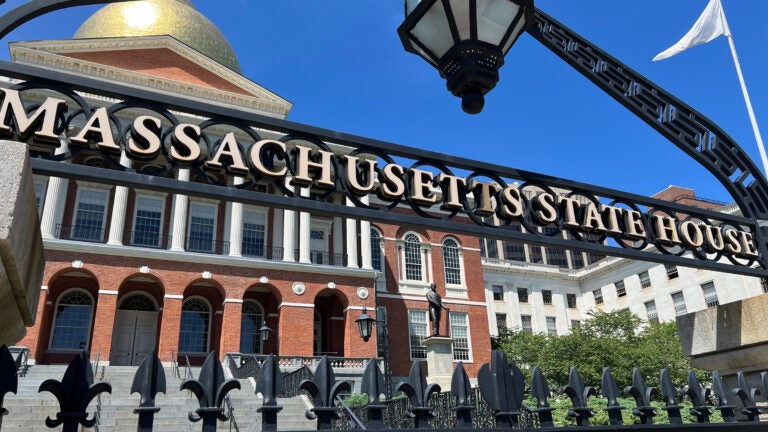
The Massachusetts State House in Boston on July 2, 2025. (Photo by Heather Hopp-Bruce)
March 23, 2026 | 2:18 PM
2 minutes to read
Artificial intelligence is quickly becoming a tool for political campaigns in Massachusetts, raising alarms over how the technology could mislead voters and shift the balance of the democratic process.
Recent examples of AI-generated content in political ads have shown that some candidates are willing to use the technology, even as lawmakers in the state struggle to regulate its use.
Lombardo’s AI ad
On March 11, Republican state representative Marc Lombardo posted a striking AI-generated attack ad on social media targeting his opponent, Daniel Darris-O’Connor, in the race for a Billerica House seat.
The ad, which took the form of an old-timey mock newspaper article, depicted Darris-O’Connor in an exaggerated pose, joining hands with New York City Mayor Zohran Mamdani.
The ad aimed to link Darris-O’Connor to Mamdani’s democratic socialist policies. Lombardo’s campaign did not respond to Boston.com’s request for comment on the ad.
A trend emerging in Massachusetts politics?
Lombardo’s use of AI is but one example of AI being used in Massachusetts politics.
In January, Republican gubernatorial candidate Brian Shortsleeve posted an ad on social media featuring a synthesized version of Governor Maura Healey’s voice.
The voice appeared to criticize Healey’s own record, raising concerns over whether such ads should be labeled as parodies or deceptive content. Shortsleeve’s campaign did not disclose the use of AI in the ad.
Some lawmakers warned that without curbing the practice, it could become a regularity in political campaigns.
“If we don’t stop it, I think this is going to be a part of campaigns and something, I believe, is out of bounds,” Senator Barry Finegold, who cochairs the Legislature’s emerging technologies committee, told the Boston Globe regarding AI content targeting Healey.
Currently, the only Massachusetts law regulating the use of AI is MGL c. 265, § 43A, which prohibits using computer-generated images for the purpose of harassment (“revenge porn”).
What’s next?
The Massachusetts State House is aware of the growing influence of AI and is considering new legislation aimed at curbing the spread of misleading political content.
In February 2026, the Massachusetts House passed two bills aimed at regulating AI for political use:
- H.5093, titled “An Act to Protect Against Election Misinformation,” which prohibits the distribution of “materially deceptive” AI-generated media within 90 days of an election.
- And H.5094, titled “An Act enhancing disclosure requirements for synthetic media in political advertising,” a proposal to require AI disclosures in political advertising ensuring voters can identify AI-generated content in political campaigns.
Both bills were referred to the Senate’s Committee on Ways and Means mid-February.
As these new legislative measures play out — and political campaigns turn to AI — we want to know your thoughts. Share your reaction with us in the form below or e-mail us at [email protected]. Your response may be featured in an upcoming Boston.com article.
AI in political advertising
Annie Jonas is a Community writer at Boston.com. She was previously a local editor at Patch and a freelancer at the Financial Times.
Sign up for the Today newsletter
Get everything you need to know to start your day, delivered right to your inbox every morning.