How “Bird Man Mike” Turned a Blink-and-You-Miss-It Sighting Into a Boston Birding Obsession
It was just another morning at the Arnold Arboretum, a botanical public park in Jamaica Plain that is home to over 15,000 types of plants.
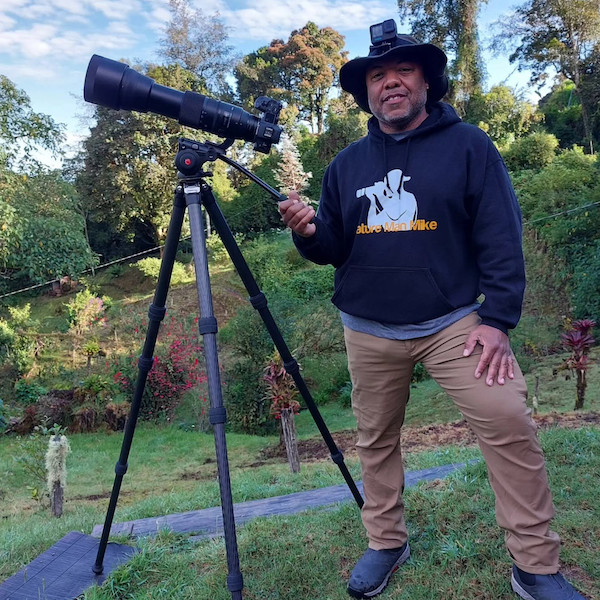
Michael Bryant, known on social media as Nature Man Mike, was on one of his routine nature walks when faster than a blink of an eye, something small, black and white flew in and out of his peripheral vision.
Was it a big bug? Was it a speck of dust? Or was he seeing things?
Thanks to Google, his wonder was short-lived.
The quick cameo appearance was made by a Black-and-white Warbler bird. He had never seen one before, despite them being frequent flyers of the Northeast during the warmer months before wintering in the South.
With 20 years of experience as a nature photographer, this millisecond moment in 2017 filled him with excitement and curiosity.
While he still shoots portraits, events and weddings, because of the Warbler, his focus has shifted almost entirely to birds and he began traveling to document the migratory patterns of his feathery friends.
Sometimes, he still has to pinch himself. “I’m on assignment to go photograph a bird? This is my life?”
BIRDING IN BOSTON
If you want to go destination bird watching, you can join one of Bryant’s international bird photography tours and workshops that he hosts throughout the year.
But, no one says you need to go that far.
Bryant often hosts guided walks and strolls at his favorite local spots, right here in Massachusetts! There are plenty of resident birds here, like the Tufted Titmouse, the Black Cap Chickadee (our state bird), Blue Jays, Robins, Cardinals, Song Sparrows, Mallards, Herring Gulls – the list goes on and on.
Shocking, I know – Apparently there are more birds in this city than the Seagulls who eat our hotdogs and the Pigeons that poop, well, everywhere.
Those resident birds above are not to be confused with the many migratory birds who sublet their time in Boston during the spring and summer and then head down south come the fall.
You’d be surprised as to what kinds of birds you could see flying around here, some might even look tropical. You just have to know where to look!
“One of my favorite winter spots [to go birding] is Castle Island, from late November to late March,” Bryant said. “It’s a great place [to see] migratory waterfowl* and a lot of birds that come down from the Arctic. That’s the place to be.”
*Waterfowl is referring to a group of birds including geese, ducks, swans, etc.
Be it in Rockport or Costa Rica, Bryant is eager to share his passion and education with anyone interested. Be sure to check this page for upcoming trips and guided walks you can join!
BIRDING TERMS 101
We can’t talk birding without making sure we are doing so correctly.
I amateurly asked Bryant what his first bird was, to which he said…”A pigeon?”
What I should have said was, “What was your spark bird?” Or, the first bird you saw that inspired your birding journey?
Because he had spent years photographing wildlife and nature, which most likely included a bird here and there, he didn’t have recollection of the very first one he ever saw or photographed. But, one could argue that the Warbler had spark material.
When asked how many birds he has seen, he claims on paper it’s only 429 but in actuality it’s way higher. This is called his life count.
Now, in terms of what to call the activity itself, it seems to be a personal preference…
“It’s generally called bird watching, but birding sounds cooler,” Bryant said. ‘Oh what are you doing tomorrow? I’m going bird watching.’ But if you say ‘I’m going birding,’ it has a ring to it. Also, bird watching is more than watching, birding is everything about birds.”
Both bird photographers and bird watchers fall under the birding category, even though the focuses are slightly different.
BIRD’S EYE VIEW
If reading this has inspired you to look with a new perspective (or through a pair of binoculars), here’s some advice from the ultimate Boston Birder. Before you know it, you’ll be able to identify the type of bird just by the sound it makes!
First, there are two apps you should download on your phone. The Merlin Bird ID app will be extremely helpful with identifying birds through sound recordings and photos. Then, with the eBird app you can report your sightings into a shareable scientific database and learn if others around you have also confirmed seeing that bird or if maybe it was a rare occurrence.
In terms of equipment, there isn’t much you need. As long as you have binoculars and maybe a granola bar or two (depending how long you are birding), the only other necessity is patience. Well, that, and the motivation to wake up at the crack of dawn. Birds are most active bright and early in the morning, which means you will be too! You know, the early bird gets the worm…
The more you get out there, the more you’ll learn and the more you’ll see the beauty in it just as Bryant does.
“I just love nature in general, but once you learn to appreciate the birds, you realize that every bird plays an important part here.”
The bird that arguably played the most important part in Bryant’s life is the black-and-white supposed “big bug” he saw out of the corner of his eye years ago.
In 2018, just a year after that encounter, he took one of his first trips down to Florida to follow the birds. On that trip, he was reunited with the Warbler and was finally able to capture some photos of it.
“Yes!” He yelled in an excited whisper, so as not to scare it away.
Now, it’s a bird he sees regularly on his trips down there.
What’s your Warbler going to be?
Follow Nature Man Mike on Instagram, subscribe to his YouTube channel and learn more at naturemanmike.com.