Welcome to the first-ever ‘NFL Draft Mailbag’ here at Boston Sports Journal. With the NFL free agent frenzy blowing through like a tornado, the main focus of the New England Patriots’ attention now turns to the NFL Draft, which is approximately one month away. There are far fewer questions entering 2026, as opposed to a year ago, when many were left wondering just how much and how fast the team could improve under first-year head coach Mike Vrabel. New England has clearly announced itself as a legitimate title contender since then. This organization could be one or two players away from finishing the job and running the table. There’s a very good chance that help may come via the draft.
New England still seeks to upgrade several positions, and we gathered several inquiries, mainly surrounding the strategy for how they will go about the selection process. We do our best to try to decipher your draft questions below. Plus, a seven-round Patriots mock draft, with projections for all 11 selections. Just a reminder to check back next week, as BSJ will be on location with exclusive reports from Boston College and UConn pro days, where New England will obviously have a strong presence, as they scout local prospects one final time.
Before we begin on our mailbag, a quick thank you to user tpsabinjr, for pointing out that Boston College head coach Bill O’Brien, who compared wideout Lewis Bond to John Metchie III, crossed paths with Metchie during his time as an offensive coordinator at Alabama (2021) and not with the Houston Texans, as noted last week. O’Brien was the head coach of Houston in 2020, while Metchie was drafted by the Texans in 2022. We do apologize for the confusion and appreciate the sharp football acumen. Now onto your inquiries …
Question from Mark Bennett: “Good work. At #31, are the Patriots likely to still have players in their top 20 on the board, and if so, they’ll take the highest ranking one?”
Thank you, Mark. When building a roster, I have always felt that selecting the best player available, particularly in round one, is the best way to collect premium talent. That said, there are only a handful of blue-chip talents available in this year’s draft. Once you get beyond the top five, the second tier of prospects is very evenly rated. It’s hard to say which players that New England might value as top 20 talents, but there are a few players that I am much higher on in that range than others. Most notably, a pair of defenders out of Texas Tech in defensive tackle Lee Hunter and linebacker Jacob Rodriguez. All they have done is produce and check off all the boxes. The biggest knock on Hunter is a lack of pass-rush (he possesses the athleticism to improve in this area), while Rodriguez has been criticized for stiff hips. It’s hard to imagine that these two won’t wind up being two of the very best from this year’s class. Surprisingly, there seems to be a lot of skepticism surrounding their draft status, but they can play for me any day of the week.
Question from clynch5687: “Ric, with your understanding of where the depth of this draft is, do you think they’re better off going edge round 1 and receiver round 2 or vice versa (knowing that it depends how the board falls to them, but in general)?”
Appreciate the question clynch. The odds are you can find an impactful wideout later in this draft, as opposed to an edge rusher. For one, nearly every organization seeks an additional pass-rusher, so these players tend to get pushed up the board–Day 2 talents wind up going on Day 1 etc., due to this. The Patriots have to be careful not to reach for a need in this instance. The premier pass-rushers might all be gone by pick No.31, so they should not settle for the best one remaining simply to address a need. There seems to be more wide receiver depth in this year’s class, and New England has had a good track record of identifying late-round wideouts, so this should be the preferred method of choice. See more in the seven-round mock below.
Question from @ZakAsatrian: “Would be interested to hear about your take on Max Klare tight end Ohio State as a possible fit – maybe he’s still available late second round?”
Good question Zak. I do believe that there is a slim possibility that Klare makes it to No.63. There is quite a gap between the top-rated tight end, Kenyon Sadiq of Oregon, and the others, so teams could look to wait a bit on the position. Eli Stowers of Vanderbilt holds a strong chance to be chosen ahead of Klare. There will likely be at least two tight ends selected in round two, so let’s say there’s a 50/50 chance. Now, if we throw Baylor pass-catcher Michael Trigg into the fold as a potential dark horse to hear his name called early, then the odds that Klare will be there for the Pats would increase.
Question from Mike In Stoneham: “Ric- absolutely love your work at BSJ and value it greatly! Thank you! Curious if you ever check out Feldman’s Freaks List and whether you see any of the elite traits guys whose production hasn’t equated to elite production yet end up being those ‘diamonds in the rough’ – I did note a few of the ‘freaks’ on your list.”
Thank YOU for the kind words Mike! Yes, very well aware of the ‘Freaks List’ and enjoy it very much. A few years ago, Iowa center Logan Jones was thought of as a potential first-round pick. Injuries have since derailed his career, but there is still great potential. He set the school record with a 705-pound squat and timed 4.90 in the forty-yard dash at 300 pounds. Jones is now viewed as a likely Day 3 selection but could turn out to be a starter, if he can remain healthy. One of the fastest players in the draft is Chris Hilton of LSU, who was also on the list and has been timed at a blistering 23.7 mph on the catapult. It should seem easy to find ways to get him the ball, right? Think again, Hilton never fully materialized during his time in Baton Rouge. However, his competitiveness and attitude are very coachable, as he is the first player believed to have participated in four all-star games (The Senior, Shrine, Hula and American Bowls). It’s possible that he can develop in the pros with the right coaching. One last player of note would be Kansas runner Daniel Hishaw Jr., who, at 5-foot-10, 220 pounds, can bench 405 pounds and registered 27 bench press reps of 225 pounds at his pro day, along with a 37” vertical jump. A power-runner who was sprinkled into the Jayhawks offense in spurts, there may be some untapped explosion in those legs, as Hishaw Jr. could be worth kicking the tires on as an undrafted free agent.
Question from FinnPatriot: “Should the Pats draft all of those even if there aren’t any good prospects left on the board that match the value of the pick? As history will tell us, if you pick a player just to fill a need, you’re probably going to have to fill that same need again a year later and the only thing you’ll have accomplished is waste a year.”
Right on Finn. As mentioned earlier, drafting the best player available (BPA) seems to be the smartest way to go about the selection process. When you start reaching to address a need, this is where the biggest mistakes can usually occur. Now, as the draft wears on, beauty is in the eye of the beholder, so best player available tends to align with team needs more in the middle and late rounds. Top talent wins out in the NFL, and quality coaches find a way to get the best players on the field. I’ve never heard of being too deep at a position. That seems like a good problem to have, in my opinion. You don’t want Huckleberries.
NEW ENGLAND PATRIOTS 7-ROUND MOCK DRAFT
Introducing our New England Patriots seven-round mock draft. Due to some shrewd trades by Eliot Wolf (among others), the Patriots own 11 draft picks for the 2026 NFL Draft, scheduled for Pittsburgh on April 23-25. First, a brief overview of our selection strategy. New England needs to strengthen the trenches and improve up front on both the offensive and defensive lines. That would seem to be a top priority, so those needs were immediately addressed. By opting to go ‘big’ early, that means injecting some fresh bodies at the skills positions would likely have to come on the final day of the draft. In our scenario below, the Patriots added a pair of playmakers to open up the passing attack. The organization also has an opportunity to strengthen the defensive secondary, and that was also accomplished in the middle rounds. On the back-end, much-needed depth was added with role players who can make an impact, plus an upgrade on special teams that should be on tap. Here’s a look at how it could all shake out next month. I look forward to your feedback and comments!
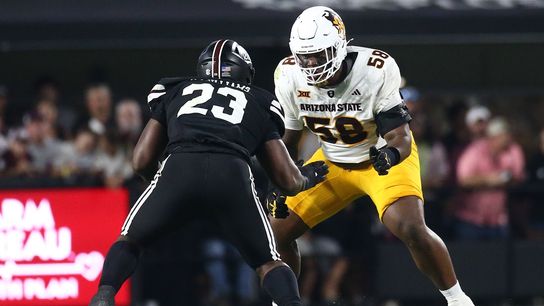
- 1st round, 31st overall – Max Iheanachor, OT, Arizona State: A run on offensive tackles is likely to occur early, so New England ought to pounce while they still can. The battle-tested Iheanachor is a true plug-and-play right tackle that would be an upgrade over Morgan Moses.
- 2nd round, 63rd overall – Gabe Jacas, Edge, Illinois: The Patriots need more pressure on the quarterback. While adding Dre’Mont Jones in free agency helps bolster the corps, Jacas brings a big-bodied frame similar to that of Harold Landry, giving the team multiple men to attack the quarterback.
- 3rd round, 95th overall – Ephesians Prysock, CB, Washington: The human condor boasts an impressive combination of size and speed. Plugging in Prysock to line up opposite of Christian Gonzalez would give the Patriots a pair of top lengthy cover-corners.
- 4th round, 125th overall – Robert Spears-Jennings, S, Oklahoma: Sticking in the secondary, Spears-Jennings is an in-the-box safety who covers immense ground sideline-to-sideline. His string frame and 4.32-speed would continue to make New England bigger, stronger, and faster on defense.
- 4th round, 131st overall – Zavion Thomas, WR, LSU: The trade rumors of disgruntled Philadelphia wideout AJ Brown continue to persist, but Thomas is more of a versatile weapon who can line up at multiple spots and bring an element of surprise to the offense on gadget plays.
- 5th round, 171st overall – Nate Boerkircher, TE, Texas A&M: A bona fide inline blocker who has flashed adequate receiving skills, Boerkircher possesses a similar skill-set to that of Austin Hooper, who departed during free agency to return to the Falcons.
- 6th round, 191st overall – Eli Heidenreich, RB, Navy: Adding a multidimensional talent such as Heidenreich would really help open up the offense and take it to the next level. His run and pass-catch ability provides shades of Danny Woodhead 2.0, as he could line up in the slot or the backfield.
- 6th round, 198th overall – Red Murdock, LB, Buffalo: One of the best-kept secrets of the draft, Murdock was a fire-starter for the Bulls’ defense, displaying incredible range, along with laying down some vicious hits. He set a new NCAA all-time record with 17 forced fumbles, bringing an innate ability to create turnovers.
- 6th round, 202nd overall – Micah Morris, OG, Georgia: A beefy guard for the Bulldogs, the powerful Morris is a road-grader in the run game, with the flexibility and experience to step in at either guard spot. While there are some athletic limitations and his ceiling may not be as high as others, Morris comes with a low floor and tremendous pedigree.
- 6th round, 212th overall – Jack Stonehouse, P, Syracuse: Considered by many to be the premier punter in this year’s draft class, Stonehouse has previously stated his affinity for Patriots special teams coach Jeremy Springer and would solidify one of the biggest weaknesses currently on the roster.
- 7th round, 247th overall – Aaron Graves, DT, Iowa: The under-publicized Graves goes about his business with a workmanlike mentality, demonstrating relentless effort and pursuit. A well-rounded player with size and athleticism, Graves is stout against the rush and can be utilized as a situational pass-rusher. An all-state athlete in high school in football, basketball, wrestling, and track!
*Certified draftnik Ric Serritella has been providing independent scouting analysis since 2002. For year-round coverage of the NFL Draft and everything pigskin, be sure to follow @nfldraftbible.