The Adelaide 36ers are headed to the 2026 Championship Series, and it’s on the back of coming out victorious in a competitive — and highly entertaining — semifinals series.
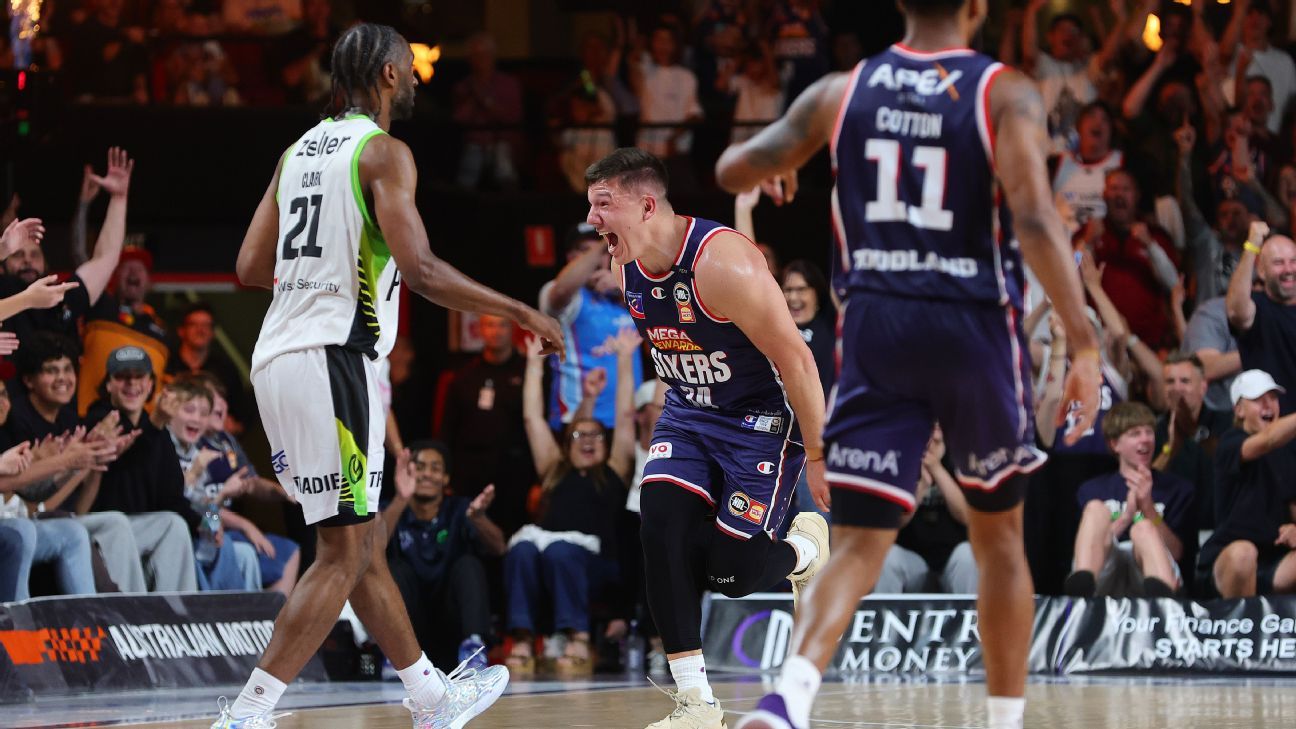
Bryce Cotton lived up to the ‘benchmark’ moniker that NBL broadcaster Jack Heverin has bestowed upon him, putting together another memorable scoring display in Tuesday’s do-or-die Game 3 win over the South East Melbourne Phoenix. The reigning MVP led the way for the 36ers, and was joined by Dejan Vasiljevic — who was inserted into the starting lineup for the first time this series — and his team’s elite frontcourt trio en route to a vital win at the sold out Adelaide Entertainment Centre.
Editor’s Picks
The 36ers sold out back-to-back Tuesday night games in this semifinals series win, demonstrating the value of home court advantage in the process, with the loud and engaged crowd in in Adelaide guiding the energy of a contest.
They now move on to face the Sydney Kings in the Championship Series, but how did they get there? From another Cotton masterclass, a strategic lineup tweak, and the impact from their dominant bigs, here’s how the 36ers overcame a feisty Phoenix to advance to the big dance.
How Cotton’s off-ball movement sparked another masterclass
This was a dominant series from Cotton.
The six-time MVP looked refreshed and rejuvenated from a long FIBA break, and ultimately averaged 36.3 points per game over the three contest, capped off by 38 points, six rebounds, and seven assists on Tuesday evening’s closeout game.
While the Phoenix had difficulty containing Cotton over the entire series, operated in a slightly different way in Game 3, especially in the first half. We saw less of Cotton dancing with the ball in his hands in the middle cylinder, and more of him playing off the ball. The Phoenix naturally applied a lot of pressure to Cotton — he was consistently top-locked and denied — and the 36ers responded by running the offence through their bigs, with the dynamic guard utilising an array of back-cuts and flares to find his separation.
Adelaide’s bigs — led by Zylan Cheatham and Isaac Humphries — are able and willing passers in those situations, while those split-seconds of separation are great looks for a shot-maker like Cotton. It came as no surprise that the 36ers’ two leading assist men at the half were Cheatham and Humphries, both of whom had four dimes apiece. In NBA terms, Cotton operated in a similar way to Stephen Curry in that first half, while Cheatham and Humphries played the connective Draymond Green role.
“We made [it] a point of emphasis,” 36ers head coach Mike Wells said post game.
“I thought, in Game 2, we got too stagnant and just played pick and roll. The way South East plays defence, and they’re in gaps, you’ve gotta get them moving a little bit, and you’ve got to get it to the second and third side. Once we did that, because they’re in gaps, they’re not quite sure how to guard a few things. The more movement and the more side-to-side was really good for us.
“The guys were outstanding about connecting, and the communication was second to none on both sides of the ball, but, yeah, we had a point of emphasis to get that thing to the second and third side.”
Cotton still operated out of the pick-and-roll throughout the game, largely in the second half, and became the first person to put up his impressive stat-line — at least 38 points, six rebounds, and seven assists — in a finals outing since Andrew Gaze did it in 1993.
The way Cotton and the 36ers leveraged the Phoenix’s ball pressure was a good test — and likely provided useful reps — ahead of a Championship Series against a similarly physical Kings team, who loaded up on Cotton throughout the regular season.
The DJ game
The big change for the 36ers going into the game was a tweak of their starting lineup, with Vasiljevic coming in for John Jenkins.
It gave the 36ers a more confident shooter — especially from that four-point range area — as well as a more forceful creator alongside the oft-hounded Cotton. Of course, there’s also the general level of comfort Vasiljevic has on an NBL floor, relative to Jenkins, who was a mid-season addition to the 36ers.
Vasiljevic hit his first shot of the game — a three on the right wing, assisted by Cotton — and was then made somewhat of a focus for Wells. Entering the second quarter, the 36ers’ first play was drawn up for Vasiljevic: a double drags screen for him to come off, off the ball, into a hand-off where he stepped into the three, which he hit. To start the third quarter, the 36ers went to a set they’ve run on multiple occasions, where action is run for Cotton on one side of the floor as a misdirection for Vasiljevic to come off a turnout; the Phoenix’s Owen Foxwell lost concentration for a second, resulting in a good look at a three for Vasiljevic on the right wing, which he hit.
“I told him two days ago that I was starting him,” Wells said of Vasiljevic.
“As soon as that game ended at South East the other night, I said ‘you’re starting’. I knew exactly what I needed to do, and I was gonna doble down with my main guys, and my veterans. Him and Bryce have a chemistry, and you see that in a lot of different ways.”
Vasiljevic also ended up being a good matchup on Nathan Sobey, who was coming off a career game but struggled on Tuesday night, shooting just 6-of-18 from the field for his 17 points.
It was a cathartic performance for Vasiljevic, who was benched earlier in the season to make way for Troy Brown Jr. and eventually Jenkins. His ability as an elite shooting threat, as well as some of the off-the-dribble juice he showed against the Phoenix, made him a more viable option to play alongside Cotton in the starting lineup, and helped the 36ers get off to a quick start.
“When I decided to bring him off the bench, he didn’t waiver,” Wells said. “It’s a testament to him and his professionalism, of what he does.”
With Vasiljevic moving into the starting lineup, Jenkins was effectively removed from the rotation; the American played just over one minute in the contest. The rotation tweak had the added benefit of refining the respective roles of both Matt Kenyon and Isaac White off the bench; both of whom provided a meaningful two-way punch at times over the series.
Dejan Vasiljevic celebrates during Adelaide’s win over the Phoenix. Photo by Sarah Reed/Getty Images
Adelaide’s bigs were dominant
It wasn’t just the passing from the 36ers’ bigs that was a difference-maker in Game 3; it was their general imposition in the paint, work-rate, and crashing that provided a meaningful edge for the home team.
While it helped that the 36ers were making shots, they were also demonstrably the hungrier team on the boards. By the end of the first quarter, the 36ers had a 16-5 advantage on the glass. That trend continued, with the 36ers winning the rebound count 52-31; that included 15 offensive boards for Adelaide. The Phoenix have been an elite rebounding team all season — and they had 13 offensive rebounds of their own — but they’re small relative to the 36ers, and the combination of Humphries, Cheatham, and Nick Rakocevic proved too much.
Wells went to the double-big lineup — Humphries and Rakocevic on the floor together — which was a little-used strategy earlier in this series, but had some success over the course of the season. Rakocevic is the league’s best offensive rebounder (17.2% OREB), while Cheatham is the best defensive rebounder in the NBL (28.5% DREB), and that was clear on Tuesday. Rakocevic pulled down four offensive boards, while Cheatham cleaned up the defensive glass, grabbing 12.
“[The Phoenix] go to the glass every time, they get the offensive rebounds and defensive rebounds, they get the second chance points, [so] that was our main focus,” Rakocevic said.
“That’s what coach got on us the most about.
“This game is about rebounding, it’s about toughness. We, as thebigs, we’re down there battling guys like John Brown, Jordi [Hunter]. We made a little pact; if we out-rebound them, we’re gonna win this game.
“We made sure that, as soon as we came out the gate, we’re gonna be aggressive. We kept that throughout the entire game.”
STAY IN THE KNOW WITH ESPN
Stay across all the big sports news — sign up to our weekly newsletters here!
SUBSCRIBE
SEM’s shooting abandons them
For the Phoenix — who were arguably the most consistent team all season — their undoing was ultimately their three-point shooting volatility.
It was the thing that hurt them in Game 1 of this series, and saw an even bigger drop-off in Game 3, where they shot just 11-of-37 from deep. That number is slightly inflated, too, because they were 5-of-26 (19.2%) from three-point range at the end of the third quarter, where the game was effectively decided.
Ian Clark’s impressive shot-making was what kept them within striking distance for most of the game — he finished with 32 points, on 5-of-7 shooting from deep — but his teammates would combine for 6-of-30 (20%) over the course of the game.
“I thought Adelaide did a really good job handling our pressure, though we still forced 19 turnovers,” Phoenix head coach Josh King said.
“We still took 21 more shots. Unfortunately, we didn’t make as many shots as we would like, and that was probably our Achilles heel in this series: we didn’t shoot the ball well, or as well as we have the entire season.
“Sometimes it goes that way. I thought we had quite a few good looks, but I could probably pinpoint that the reason we lost this series is because we didn’t shoot the basketball as well, collectively as we did the entire season.”
It was the same story in Game 1, where the Phoenix shot 12-of-43 (27.9%) from beyond the three-point line in a loss. King’s team has relied on its volume three-point shooting all season long and, in a best-of-three series, it’s the type of variable that could determine the outcome of your season.
There was also an element of the style of officiating in Game 3, which was relatively tight; something that obviously doesn’t favour the Phoenix’s high-pressure, up-and-in style of defence. The fouls called against the Phoenix were most likely fouls, to be sure, but the inconsistency in the way games are officiated from game to game makes it very difficult for a King-led team to operate effectively within their play-style. The foul calls led to frustration, and the Phoenix ultimately gave in to their emotions, with multiple players, as well as King, picking up technical fouls across the game.
All in all, it was another broadly successful season for the Phoenix, who had the best regular season finish of the franchise’s short history, were a top-two offence and top-three defence, had an inspired, resurgent season from Sobey, and boast one of the best coaches in the NBL.
“We’re close,” King said.
“We’re raising the expectation at South East Melbourne, but we’ve still got steps to take. I love the direction our program is headed.”