Politics
“It’s time we start using the tremendous wealth in this state to invest in people’s needs.”
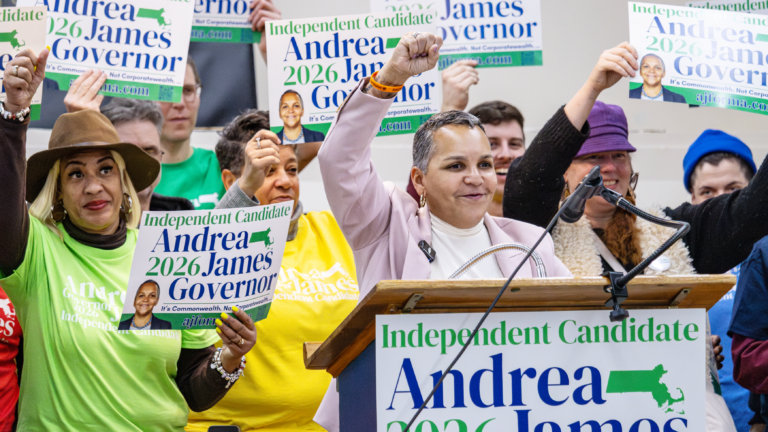
Andrea James, a criminal justice advocate, is running for governor as an independent. Kristy Coleman
As Gov. Maura Healey runs for reelection, a trio of Republican candidates are duking it out in a primary battle with the hopes of facing her in the general election in November. But another candidate, an independent, is hoping to disrupt the race. Andrea James, a community organizer and criminal justice advocate who has focused on supporting incarcerated women, is making a longshot bid to be governor.
She is not a conventional candidate: James was convicted of and sentenced to two years in prison on federal wire fraud charges. The former real estate attorney was disbarred in 2010 after being accused of misappropriating client funds and defrauding mortgage lenders and homeowners.
In the decade-plus since serving her prison sentence, James has openly embraced her history and used it to inform her advocacy work. Now she is seeking political office for the first time, running on a populist and progressive platform that centers a message of putting “people before profit.”
Boston.com caught up with James recently to find out more about her history and her vision for Massachusetts.
The following interview has been condensed and lightly edited for publication.
Boston.com: Tell me a bit about yourself, your history being incarcerated, and how it led you onto the path that you’re on today.
Andrea James: The path that I’m on today didn’t start with a serious mistake that I made long ago in my law practice. I was raised in Roxbury. My family’s been here for seven generations. We’ve lived in the same house for five. I come from a family of activists and educators, and my grandmother broke the color barrier for black nurses here at Boston City Hospital. This campaign didn’t just happen because I was incarcerated.
I made a very serious mistake many years ago as a lawyer. Primarily, my practice was criminal defense work, and I started to do closings for banks and, at the time, we didn’t even know the term predatory lending. I want to be very clear about it: My transgression, the mistake that I made was to misappropriate money that belonged to the banks, who were all predatory lenders. The reason that I went to law school at Northeastern University was to practice on behalf of people who were struggling in the criminal law system. My work around this started years, decades before. As a child, that’s all I ever wanted to be, was a criminal defense attorney. For the most part, I didn’t have paying clients. I was a bar advocate. I did that work, and was very proud of it.
A small portion of my work was real estate conveyance, closing loans for banks, and the banks were my clients in the transgression that happened that landed me in prison. I did not participate in predatory lending. As a matter of fact, we did all we could in my law office to help as the more egregious, predatory loan products came out; we did everything we could to help to educate and inform families like mine, who had lived in their homes for generations, to not take these loans because they were predatory.
I was sentenced in 2009, and the transgression happened years before that. Let me just say one thing very clearly: I take and have taken full responsibility. I self-reported my transgression. I voluntarily surrendered my license to practice law, which was one of the most heart-wrenching things ever, and I believe in full transparency and accountability. I knew I made a serious mistake trying to use money that belonged to banks to cover up a mistake that I made in my law practice. It was just horrible. I have stood on transparency and accountability, not just because now I’m running and we expect it from our government, but because I’ve known what it’s like to stand in the heat, to take responsibility, and to be accountable.
Tell me about what your advocacy work has been like since you got out of prison.
As somebody who was very well educated, who had come from a family that understood the history from slavery to mass incarceration, I knew exactly what I was witnessing inside of a prison crammed full of predominantly black, brown, and poor women, who did not need to be incarcerated. They needed help.
I was very fortunate. I am not the poster woman for incarcerated women. I had a family, I had a husband, I have parents, my children were safe. They stayed home. They stayed in their schools. They continued to be educated. They were fed every evening. I remember being in a women’s prison at three o’clock in the morning and hearing a woman sobbing because she just cannot stand another moment of separation from her children. This leads to generational incarceration, which we see here in Massachusetts. It leads to generational poverty, and it does not do anything.
Many of the people who are working on policy now, they’ve never had the alchemy of life experiences that I’ve had, and so the policies that they create are policies that aren’t public safety. They have nothing to do with public safety, relying on policing and prison as this infrastructure for public safety is absolutely ridiculous. Hurt people hurt people. Healthy people have an opportunity to thrive.
I’ve spent 15 years building organizations. I built one here in Roxbury that has been working to stop a proposed $360 million women’s prison in Massachusetts, which is absolutely fiscally irresponsible. We have one of the lowest incarcerated populations of women in the country. We could be a shining example to the rest of the country. We’ve done more than 10 years of research on that, on what else is possible than just throwing people in a prison and not providing real things that would help them transform their lives. I’ve also created a national, multi-million dollar organization that I have raised every dime for. I have managed and grown that budget over the years. We’ve worked with the Obama administration, the Biden administration, each of their justice departments, their education departments. We’ve worked with the Sentencing Commission. We’ve helped coach more than 100 women out of draconian drug war sentences where they were over-criminalized and over-sentenced. I founded the National Council For Incarcerated and Formerly Incarcerated Women and Girls, which is a global network of women who are working collectively.
How did you make the decision to run for governor?
I’m not a politician. I don’t intend on being this career politician. I have never run for any office. But at some point you really just have to take a stand. For far too long, both parties have catered to wealthy donors and not the people of Massachusetts.
The line in the sand for me, really, was going to these hearings at the State House, the last one that I testified at was about reinstating the right to vote for incarcerated people. Massachusetts wants to continue to paint itself as a state that does not have voter disenfranchisement, but we do. People from all across the state testified that we need to not have any voter disenfranchisement, and the committee never even discussed it. After people come and pour their hearts out, they’re not required to ever come back to the table and ever discuss it or even say why they didn’t vote this out of committee. People are fighting for all of these things, housing, health care, education, labor. These bills come up, and we have one of the least productive legislatures in the country. That was it for me.
I’m running because the Massachusetts economy leaves too many people out. No matter what the Healey administration tells us about how great the economy is, the truth is that it’s not great for most people. It’s time we start using the tremendous wealth in this state to invest in people’s needs.
Why are you running as an independent?
I’ve been a Democrat my entire life. I was a delegate at the convention in September. Whoever was in control of the platform committee at the time, just decided that in the 11th hour, in the dark of the night, they were going to cleanse the Democratic platform of all of the things that advocates have been working for: government transparency, single-payer health care, environmental issues, labor protections, and of course, the work that we’ve done on a proposed moratorium on new prison construction. Leadership has not worked to advance any of these issues, but they are part of the Democratic Party platform. We had to gather signatures within a very short period of time, we had to go on to the floor and fight to get those things put back on the platform.
The Democratic Party has lost its way. The focus no longer is on the needs of the people. It has shifted more to presenting itself as very similar to the Republican Party. They are adhering to wealthy donors and not to the needs of the people. In good conscience, I decided it was time to unenroll, and I decided to run as an independent. The parties seem to have turned into fundraising organizations, and both of the parties work for wealthy donors. They don’t work for the people.
We’re a blue state, and yet we still cannot get the issues over the line that have been on our Democratic platform for years. I want to run on the issues and keep a focus on the issues.
How do you see the landscape of the race right now and assess the challenges of being an independent candidate?
Unfortunately, the mainstream media is supporting this. We’re fighting for democracy, and we’re fighting for the voices to be heard that are consistently pushed out. This race is another demonstration of that. We have grassroots dollars, and we’re just starting to really ramp up our donations. But we’re running against people who are millionaires. We’re running against people who have poured their own money into a race so that they can be heard. We’re running against three people, Republicans, who supported Trump and continue to support Donald Trump and his policies. And we have Maura Healey, who has demonstrated that many of the things that the people are asking for, she does not support.
We’re running to win. We are absolutely throwing everything that we can into this race, and I am determined to win. I’m not under any illusion. We don’t have wealthy donors that are supporting this campaign. We have working people, we have underemployed people, we have single mothers who are giving us $10 donations. It’s a real grassroots campaign.
We’re trying to create this platform for people to have their voices heard and to have a race that does not completely carve out the truth of what is happening. Our economy right now leaves too many people out. No matter what Maura Healey tells us, the truth is, it’s not great for most people.
Anything else you want to add?
We need housing. We need to stabilize rent. We need to build quality public mixed-income housing, affordable housing. We need to figure out how to lower and control energy costs. We need health care. We need to establish a state system that covers all health care for everyone with no copays or deductibles. We need fully-funded schools in every city in town, and we need to raise the minimum wage to $25, fund free child care so that people can work. These are things that will relieve families in one of the wealthiest states in the country, to actually allow them to thrive instead of just struggling every single day to survive. We need a governor that will focus on the needs of the people and not just the privileged few in the commonwealth.
Ross Cristantiello
Ross Cristantiello, a general assignment news reporter for Boston.com since 2022, covers local politics, crime, the environment, and more.
Sign up for the Today newsletter
Get everything you need to know to start your day, delivered right to your inbox every morning.