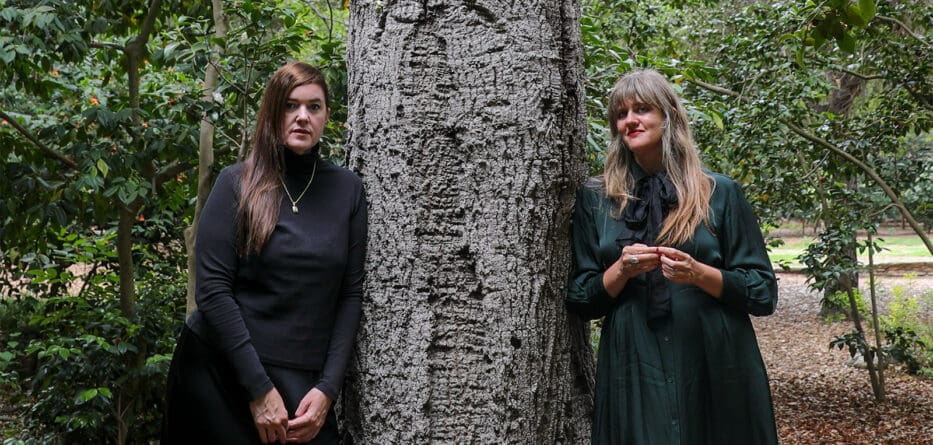
“Having lived there for so long, playing First Unitarian Church is always especially wonderful, and getting to play the Sanctuary, especially, feels like a major accomplishment,” says harpist, composer, and one-time (and longtime) Philadelphia resident Mary Lattimore during a phone chat last month. Our discussion was cut short due to a lack of reception that accompanied a seven-hour drive through Oregon where Lattimore was accompanied by composer, vocalist, producer, and longtime collaborator Julianna Barwick, with whom she recently released a collaborative album, Tragic Magic, which dropped January 16th via InFiné.
At the time of our chat, Barwick and Lattimore – who have been friends and tourmates for years and collaborated on 2021’s “Canyon Lights,” in addition to “Oh, Memory,” a track on Barwick’s 2020 album Healing Is a Miracle, which also features contributions from Sigur Rós vocalist Jónsi and Nosaj Thing – are returning to Los Angeles (where they’re both now based) from a run of West Coast dates in support of Tragic Magic, whose first night was a sold-out LA show at a brand-new venue (Sid The Cat Auditorium) with all of their friends in attendance, something they tell me was incredibly gratifying.
Last night Julianna and Mary played Chicago to kick off their next batch of dates, which will have them headlining The Sanctuary of the First Unitarian Church next Friday, March 20th, for a currently sold out show (Click here to get on the waiting list.) that will feature a supporting set from Philadelphia legend and frequent Mary Lattimore collaborator Jeff Zeigler. “I think Jeff’s doing an ambient-ish project, so I look forward to see what he’ll be doing,” Mary tells me when I ask if she knows what can be expected of his opening performance.
When I ask what can be expected of their own set, Julianna tells me that it will likely be about an hour, including tracks from Tragic Magic and their previous collaborations, in addition to some of Lattimore’s solo material that Barwick will croon over, something she says she’s really been enjoying: “Usually with my solo music, there aren’t meaningful lyrics for the most part, so I’m stretching a new muscle, which is really rewarding.” And Mary tells me that the responses the collaborators have been getting in a live setting have been exceptionally rewarding, as well: “There’s just been so many people that’ve been really moved… On the planet, it feels like such a gross, volatile time, so people are open to it… To me, vulnerability is the ultimate compliment.”
Tragic Magic came together over the course of just nine days in Paris, where Barwick and Lattimore worked with co-producer Trevor Spencer, who provided additional production and mixing on Lattimore’s previous LP, 2023’s Goodbye, Hotel Arkada (He’s also worked with PHILTHY phriends Pure Bathing Culture, Chastity Belt, and Aaron Lee Tasjan.) “It was all totally new to us, and he just has a masterful ear and he had the ability to analyze what we needed working with these instruments from older times,” Lattimore explains of the trio’s dynamic.
The old instruments Mary’s referring to come from the collection of the Philharmonie de Paris’ Musée de la Musique in partnership with InFiné. Lattimore chose three harps that she felt helped to define the evolution of the instrument, dating from 1728 to 1873, while Barwick worked with a number of analog synthesizers that have played significant roles in shaping exploratory music, including the Roland JUPITER and Sequential Circuits PROPHET-5. Tragic Magic track “The Four Sleeping Princesses” was actually inspired by InFiné’s Alexandre Cazac saying to Mary something along the lines of, “Oh, you’re gonna wake up the sleeping princesses,” as she surveyed the museum’s harp collection.
“The Four Sleeping Princesses” wasn’t the only Tragic Magic song inspired by Barwick, Lattimore, and [often] Spencer’s experiences during those nine days in Paris. Album opener “Perpetual Adoration” was inspired by the emotion evoked from a visit to the Basilica of Sacré Cœur de Montmartre, where they witnessed a nun singing above organ drones during a Sunday Mass inside of cathedral bearing a sign that read, “ADORATION PERPÉTUELLE.” Similarly, “Haze With No Haze” was inspired by a trip to an exhibit from James Turrell, whose 2021 Skyspace exhibit at Mass MoCa was actually opened by Barwick and Lattimore.
The seven songs of Tragic Magic, as characterized in the album’s press release, serve as, “a meditation on tragedy, wonder, and the restorative power of shared experience,” sentiments brought about by the wildfires that ravished Barwick and Lattimore’s community shortly before their Paris trip. The LP’s closing track, “Melted Moon,” is an explicit reflection on living amongst that chaos and Barwick pondering how to prepare for the trip while not knowing if returning to her home would even be an option.
In addition to the five tracks written by Barwick and Lattimore, Tragic Magic also includes two covers, one of which has significant ties to the City of Brotherly Love and Sisterly Affection. Their arrangement of Vangelis’ “Rachel’s Song” (famously composed for, but not featured in, Blade Runner) — which opens with a slowed-down recording of the first rain after the LA fires, courtesy of friend and visual collaborator Rachael Cassells — debuted in its original form during Mary Lattimore & Julianna Barwick’s set for the 2023 edition of Making Time ∞ at Fort Mifflin, which I’m guessing many of you attended…