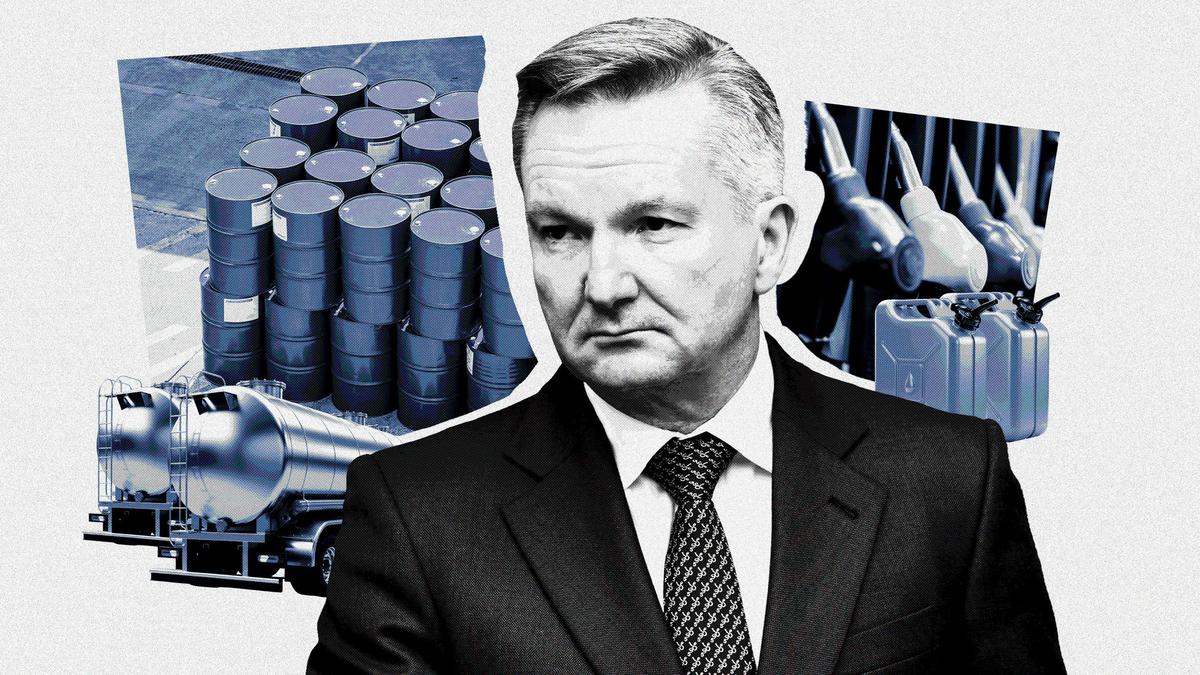
Energy Minister Chris Bowen has not ruled out relaxing Australia’s total ban on importing Russian oil and petrol following reports China may halt its exports to Australia.
“We don’t like Russian oil anymore than anyone else. But we do have a complicated supply chain where oil from different countries gets mixed in to broader supplies,” he told reporters in Sydney on Saturday.
“We maintain our opposition to Vladimir Putin’s actions, but we are dealing at the moment with an immediate domestic issue.”
Sign up to The Nightly’s newsletters.
Get the first look at the digital newspaper, curated daily stories and breaking headlines delivered to your inbox.
By continuing you agree to our Terms and Privacy Policy.
It follows the United States loosening its own grip on sanctions against Russian oil shipments in a bid to boost the reach of existing global supply.
US Treasury Secretary Scott Bessent said the short-term measure was designed to stabilise the market, with US sanctions set to be lifted for 30 days.
“This narrowly tailored, short-term measure applies only to oil already in transit and will not provide significant financial benefit to the Russian government, which derives the majority of its energy revenue from taxes assessed at the point of extraction,” Mr Bessent said via X.
US Treasury Secretary Scott Bessent called the move a “short-term measure”. Credit: FABRICE COFFRINI/AFP
The move has angered global allies, drawing criticism from leaders across the European Union and Canada.
The market remains shaky amid the uncertainty of the Middle East conflict and its potential to substantially impact fuel, diesel and jet fuel supply.
Mr Bowen said while he was happy with the way jet fuel supply was being managed, he was concerned by the “real and unacceptable shortages in rural and regional areas”.
“We’ve been dealing with a massive explosion in demand. Demand up 100 per cent at every terminal across Australia,” he said.
It follows the Federal Government’s announcement it would release fuel from its emergency stockpile to meet the spike in rural and regional demand.
There was no release of jet fuel from the stockpile, as the minister said Australia was “not facing any immediate shortage of jet fuel”.
“They (Qantas and Virgin) have fuel on hand for the immediate and foreseeable future, but obviously, any impacts from global supply will be something that we very carefully monitor,” Mr Bowen said.
Australia’s major airlines Qantas and Virgin continue to closely monitor the changing landscape.
“We’ve been in regular contact with the Government and major fuel suppliers who are providing us with a level of confidence about current jet fuel supplies in Australia,” a Qantas spokesman said.
“But given the uncertainty of the Middle East conflict and the potential impact on jet fuel supply chain we are continuing to monitor the situation closely.”
A Virgin Australia spokeswoman said the airline “continues to assess the implications of fuel price increases”.
“We have received assurances from our fuel suppliers regarding our near-term fuel requirements,” she said.
It poses questions over Australia’s contingency plans should China press pause on exports long-term.
“We’re in regular contact, both the Foreign Minister (Penny Wong) and I, with our counterparts about (fuel supply),” Mr Bowen said.
“(South) Korea is a particularly important source of refined fuel . . . not so much jet fuel but the other two, to Australia, and we continue to engage very carefully with them.”