Local News
Experts are increasingly worried about the abundance of synthetic kratom products that carry a range of health risks.
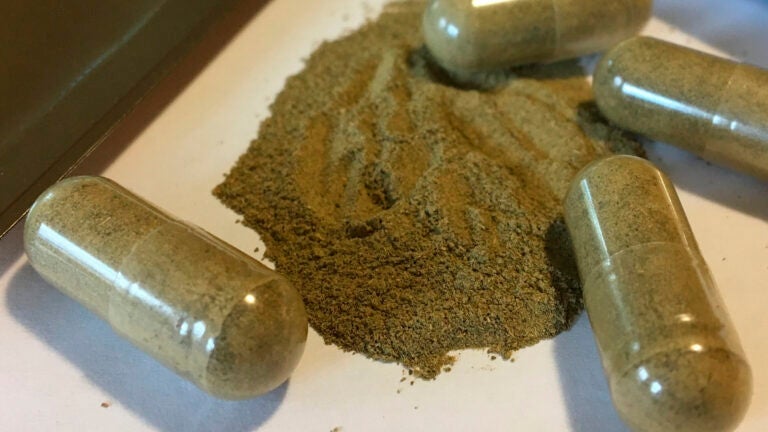
Kratom capsules. Mary Esch / AP, File
Some Boston City Council members are preparing to draft an ordinance that would ban kratom, a substance widely available in the city that can mimic the effects of opioids and stimulants.
Councilors heard testimony from experts, a city official, and people who said that kratom was responsible for the deaths of their loved ones during a hearing on Monday. While not every council member has taken a stance, many of those who spoke during the hearing expressed alarm at the ease with which customers can buy kratom in Boston. They asked about the specifics of how a ban could be implemented, and there appears to be significant support for such an ordinance.
Councilor John FitzGerald, who chaired the hearing, said during the council’s full meeting on Wednesday that a working session is needed in order to formulate the specifics of an ordinance that would ban kratom sales.
“The status quo is not an option. We have to ban it here in Boston,” Councilor Ed Flynn said during the hearing.
Kratom refers to both a tree native to southeast Asia and products derived from its leaves. There is particular concern among officials and experts about 7-hydroxymitragynine, or 7-OH, a potent compound found in kratom. In recent years, products that contain synthetically enhanced amounts of 7-OH have proliferated in smoke shops and convenience stores around the country.
These products can take the form of tablets, gummies, drink mixes, and shots that are often marketed as energy supplements. Public health officials are worried that these can be particularly appealing to young people and are easily bought in many states. The FDA describes 7-OH products as a major concern and last year ramped up public education about the risks associated with its use.
PJ McCann, deputy commissioner for policy and planning at the Boston Public Health Commission, called kratom a “serious emerging concern” and said that the BPHC is monitoring the increased use of 7-OH products. These pose additional risks, including the potential that they are contaminated with salmonella or concerning levels of heavy metals.
Some BPHC staff members have worked with people who use these products to manage opioid addiction, saying that it helps alleviate their cravings. While there is some evidence that this could be effective in ongoing research studies, no products have been approved by federal regulators for these purposes, McCann said. The BPHC does not recommend kratom, or 7-OH use, for any reason.
Nonnie Estella, a surgical gynecologist who was the president of medical staff at Lowell General Hospital before retiring, told councilors that she first became aware of kratom through elderly patients from Southeast Asia who brewed tea with its leaves. But she has witnessed the explosion of 7-OH products firsthand, she said as she described a range of risks associated with them.
“It’s just made way too accessible,” Estella said. “I think what’s occurred in many ways is that it has slipped through all the silos we’ve created. We have a silo for tobacco and alcohol, we have a silo for cannabinoids, all of these supplements don’t live under a silo.”
More than 20 other cities and towns in Massachusetts have banned kratom sales, Councilor Erin Murphy said, and more are considering bans of their own. States like Vermont and Rhode Island have taken action to ban kratom sales on a state level, and there is pending legislation on Beacon Hill that would regulate it in Massachusetts.
Similar concerns were raised about synthetic cannabis, or “K2,” in 2015 in Boston. The City Council adopted an ordinance banning the substance. Kratom, however, binds to opioid receptors, not cannabinoid receptors, and therefore is not regulated under the 2015 ordinance.
“It feels like we’re just playing Whac-A-Mole with all these substances,” Councilor Sharon Durkan said. “This is so clearly something that should not fall through the regulatory cracks.”
When asked about the pending statewide legislation, McCann said that he could not speak to the Wu administration’s official stance toward the bill. However, city officials have “strongly suggested” in individual conversations with lawmakers that this issue is “crying out for regulation at the state level” given the groundswell of individual municipalities working to enact bans, he said.
While 7-OH products are the focus of many officials, others say that all kratom products need to be banned. Holly Trouville, who testified during the hearing, said that her 25-year-old son Tyrell died in 2024 after ingesting a kratom seltzer.
“I have nothing to gain by being here today, my son is already gone. My only goal is to prevent another parent from feeling the complete and utter devastation I feel on a daily basis,” she said.
Ross Cristantiello
Ross Cristantiello, a general assignment news reporter for Boston.com since 2022, covers local politics, crime, the environment, and more.
Sign up for the Today newsletter
Get everything you need to know to start your day, delivered right to your inbox every morning.