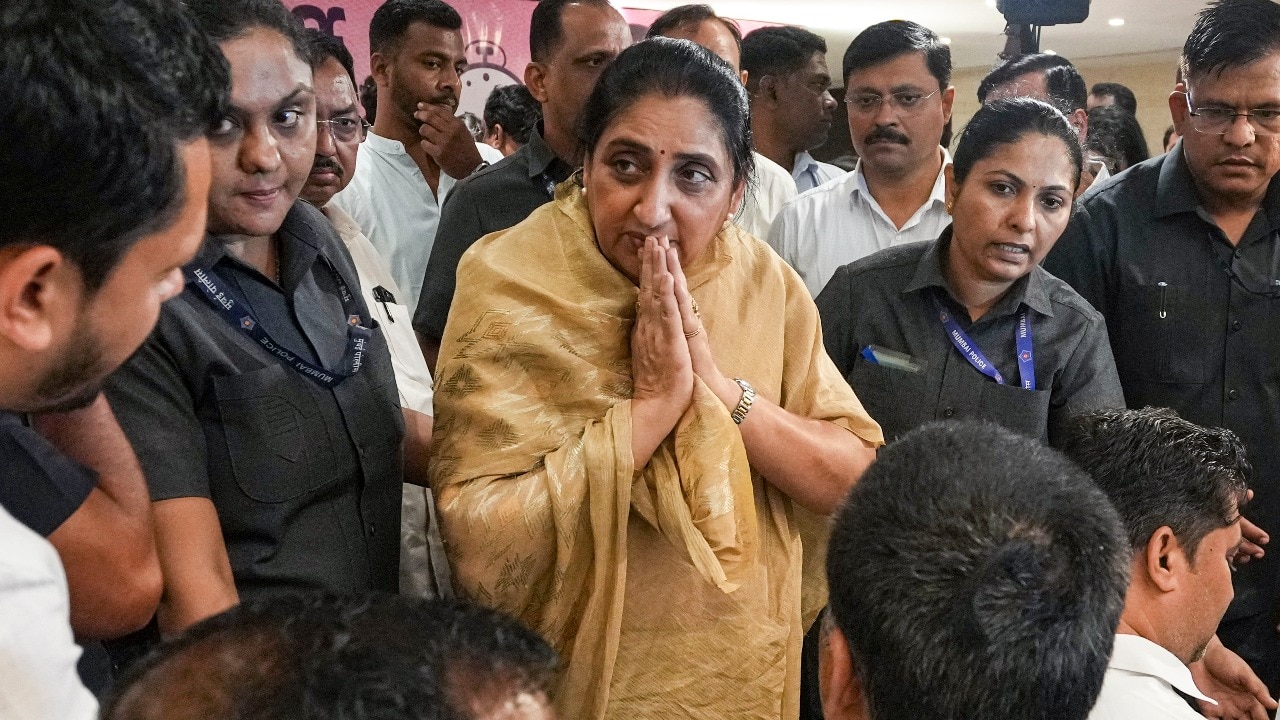
Maharashtra Deputy Chief Minister Sunetra Pawar.
| Photo Credit: SHASHANK PARADE
Deputy Chief Minister Sunetra Pawar stated that women employees who report for duty at 9.15 a.m. will be permitted to leave the office 30 minutes earlier in the evening
Deputy Chief Minister Sunetra Pawar, in her inaugural address to the Legislative Council, announced the introduction of a ‘Come Early, Go Early’ scheme for women government employees in the Mumbai Metropolitan Region (MMR). The announcement was made on the occasion of International Women’s Day.
Ms. Pawar stated that women employees who report for duty at 9.15 a.m. will be permitted to leave the office 30 minutes earlier in the evening. The stated objective of the policy is to assist women in managing their professional and domestic responsibilities. The decision follows discussions held in the House on women’s issues, where members, including male legislators, contributed suggestions.
The scheme is intended to ease the commute for women by allowing them to avoid peak traffic hours. Under the outlined terms, employees arriving between 9.15 a.m. and 9.45 a.m. will be allowed to leave after completing their scheduled work hours, with the early departure time corresponding to the time of their arrival.
During her address, the Deputy Chief Minister also provided an overview of other government initiatives. She mentioned schemes such as ‘Ladki Bahin’, ‘Lek Ladki’, and ‘Annapurna’, stating that the government is focused on their implementation. She further noted the government’s intention to introduce stricter laws to address financial fraud occurring through online platforms.
In a separate discussion on a proposal related to Women’s Day, Ms. Pawar reiterated the government’s commitment to women’s development. She called for collective efforts to build a society that ensures respect, opportunities, and security for women.
Data on missing persons presented
The government also shared data regarding efforts to trace missing persons. Under the ‘Operation Muskan’ initiative, 42,594 children have been located across 14 campaigns conducted between July 2015 and February 2026. Through the ‘Operation Search’ campaign, authorities have traced 5,066 women and 2,771 children. It was informed that ‘Missing Cells’ are operational in all districts, and 51 ‘Bharosa Cells’ have been activated to address issues related to women.
Overview of welfare measures
The administration provided details on several schemes aimed at the economic empowerment of women, including ‘Lakhpati Didi’ and ‘Namo Mahila Sashaktikaran’. To provide market access for products made by self-help groups, platforms such as ‘Umed Mall’ and ‘Mahalaxmi Saras’ have been introduced, with products also available on online portals.
Regarding the welfare of anganwadi workers, the government stated it is considering improvements to their remuneration and infrastructure. It was reported that drinking water facilities have been installed at 17,254 anganwadi centres. Measures to enhance women’s safety include the deployment of technology and the establishment of systems at Chhatrapati Shivaji Maharaj Terminus, Churchgate, and Borivali stations to address cyber crimes.
For women in government service, the administration has approved 180 days of maternity leave. Additionally, provision for half-pay leave without a medical certificate, for a maximum period of one year following maternity leave, has been made. The state has also implemented its Fourth Women’s Policy and constituted a high-level committee for its execution. In rural areas, the ‘Adi Shakti Abhiyan’ is being implemented with the stated goals of preventing child marriage, creating violence-free villages, and reducing the dropout rate among girls.
Published – March 11, 2026 12:30 am IST