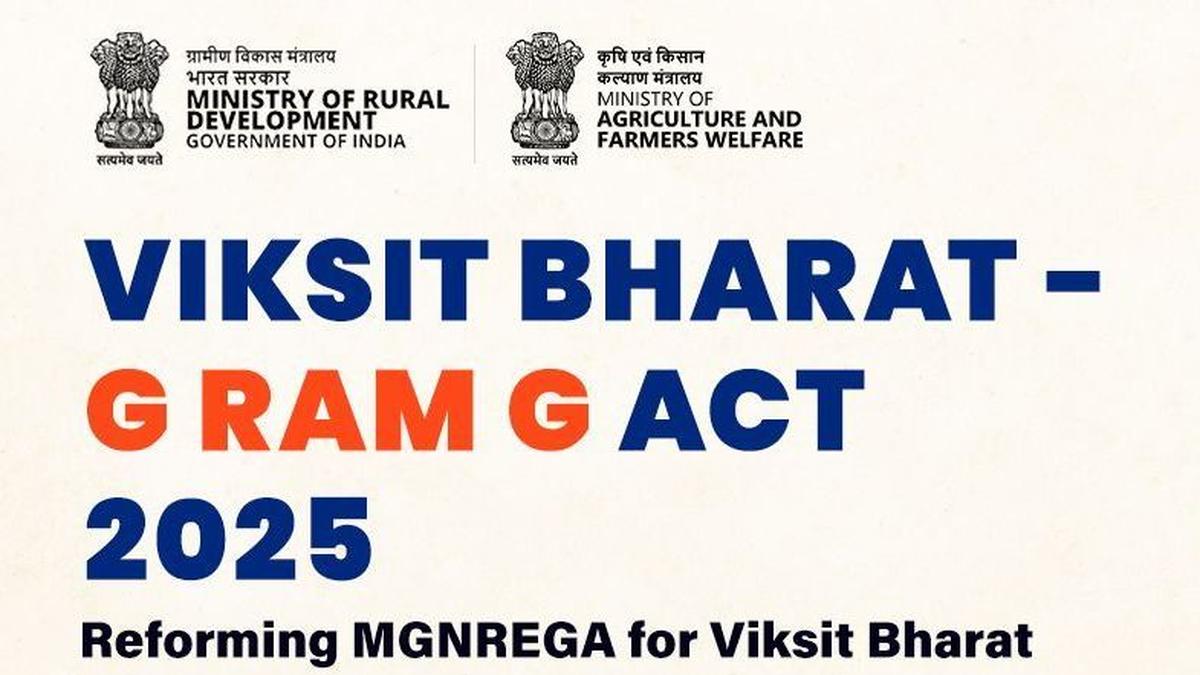
There are several tricky issues that the Centre must navigate, including a formula for “normative allocation” for the States. Photo: india.gov.in
The Viksit Bharat – Guarantee for Rozgar and Ajeevika Mission (Gramin) Bill, 2025, which was passed by Parliament within two days of its introduction on December 16 last year, has several steps to clear before it can be implemented. The new rural employment legislation replaces the Congress-led UPA government’s flagship scheme, the Mahatma Gandhi National Rural Employment Guarantee Act, 2005 (MGNREGA).
Also Read | Change for the worse: On MGNREGA to VB-G RAM G
According to sources, the Union Ministry of Rural Development is holding weekly consultation meetings with State Governments. There are several tricky issues that the Centre must navigate, including a formula for “normative allocation” for the States. Section 4(5) of the legislation says, “The Central government shall determine the state-wise normative allocation for each financial year, based on objective parameters as may be prescribed by the Central government.” This clause is intended to ensure a more equitable distribution of resources, following complaints from several economically weaker States that they receive a smaller proportion of funds. These objective parameters are yet to be finalised.
“Several State governments that were among the best performers under MGNREGA argue that the objective parameters should also take into account their past performance, while other States contend that the parameters should reflect the demand in a State, especially in those with high rates of migration of rural workers,” a senior official of the Ministry of Rural Development said.
The legislation requires that all Gram Panchayats be categorised as A, B, or C, based on development parameters. The Act cites only one example — “proximity to urban areas” — of what these “development parameters” could entail. The Centre, currently in consultation with the States, is working on framing these parameters. This categorisation, as the Act states, is meant to address the “varying needs of the Panchayats”.
For the scheme to roll out, State governments must have at least five basic elements in place, a top official said. These include ensuring that ongoing work under the old legislation — MGNREGA — is completed. Second, the States must enrol themselves on DBT Sparsh, a banking platform. For the first time since the launch of the rural employment scheme, the Centre and the States will share the financial burden. West Bengal has not yet enrolled on the platform, according to sources. Third, the ongoing drive to conduct e‑Know Your Customer (EKYC)verification of MGNREGA job cards must be completed. At present, 83% of active workers — defined as anyone who has worked at least once under the programme in the past three years — have completed eKYC. These eKYC-enabled job cards, the senior official said, will continue to be valid under the VB‑G RAM G Act until the government replaces them with a smart card. Finally, State governments must onboard Yuktdhara, a geospatial planning portal that the Centre wants used for preparing the Viksit Gram Panchayat plan, which will function like a master schedule of all works planned for the year.
The Centre also has to frame rules under eleven categories, for example on social audit of the scheme.
Sources indicated that the new legislation may not be ready for rollout by April 1 this year. From the day the new Act is notified by the Centre — which will be treated as the commencement date — the State governments will have six months to implement the scheme.
The Union Budget earmarked ₹95,692.31 crore for VB‑GRAM G and ₹30,000 crore for MGNREGS, taking the combined allocation for the two rural employment heads to ₹1,25,692.31 crore. The government has projected this as a 43% increase over the Revised Estimate of ₹88,000 crore for MGNREGS in 2025‑26.
Published – March 08, 2026 11:08 pm IST