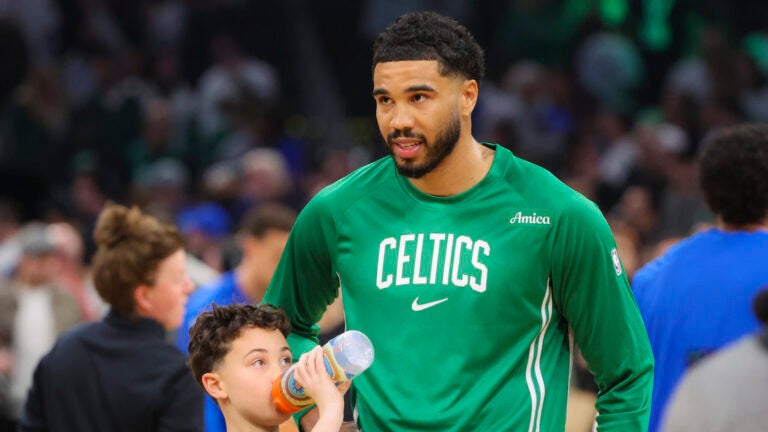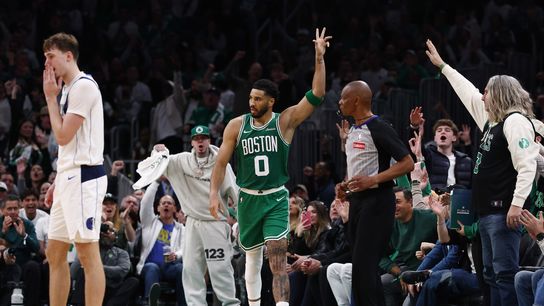
BOSTON — It was a beautiful night at TD Garden. The Boston Celtics’ matchup against the Dallas Mavericks played second fiddle to the real story: Jayson Tatum’s return.
For the first time in 298 days, Tatum suited up for NBA action, and the atmosphere was electric. More on that in another article. This is about the basketball.
How did Tatum look? And perhaps more importantly, what does it mean for the Celtics?
It didn’t happen right away for Tatum. In fact, his first few attempts consisted of some tough misses. He even airballed a shot. But once the shots began to flow, they flowed.
After missing his first six shots of the game, Tatum went 6-for-10 for the remainder of the game, including some classic pick-and-roll buckets.
The adrenaline finally wore off, and he was able to slowly drift into the best version of himself, especially from a scoring perspective.
2. Jayson Tatum, the passer
But while Tatum’s scoring numbers took a few minutes to load, his playmaking was impressive from the jump.
Neemias Queta has been in Boston for a few years now, but this season has been his first opportunity to play big-time minutes. Thus, Tatum has yet to experience that.
You wouldn’t know that from their first chance to run a pick-and-roll together on Friday night.
Cooper Flagg went over the screen, Dwight Powell was stuck in the in between, and Tatum lobbed up a pass to Queta.
Queta threw it down, screamed to the heavens, and the game got rolling.
Not long after, Tatum and Queta found themselves in a similar situation. But this time, Flagg was on top of it.
Instead of staying behind Tatum, he shifted over and tried to block the lob attempt at the rim. He got called for the foul (which he wasn’t too pleased about).
This is the type of pass very few players can make. Tatum is one of them.
3. The real Jayson Tatum impact
The scoring was fun. The passing was a treat. But the biggest impact Tatum will make on this Celtics team is just being Tatum.
Watch this play from the Celtics’ game against the Mavericks on February 3.
Jaylen Brown works out of a Luka Garza screen, but Flagg helps up from the corner. He was guarding Hugo Gonzalez.
Gonzalez cuts baseline, but Daniel Gafford meets him at the rim. Flagg was willing to help off Gonzalez in order to put more pressure on Brown.
Now, watch this play from Friday night.
Derrick White gets into the middle of the floor with the shot clock winding down, but Flagg is right there. He has the chance to help cut off White.
But he doesn’t. White buries the jumper.
Max Christie doesn’t help, either. He could have jumped in at the very beginning of the play and prevented White from getting downhill. But he didn’t.
That’s because Flagg was guarding Tatum, and Christie was guarding Brown. They didn’t want to leave their sides. That’s elite gravity.
Here’s another set of examples.
Payton Pritchard drives against the Mavericks (back on February 3), but Flagg and Gafford are there. They helped over in the paint and ended up swatting Pritchard’s shot away.
Brown is all the way at the halfway line, trying to space the floor. He gets his man (relatively) out of the play, but it wasn’t enough.
Now here, on Friday night, White runs a pick-and-roll with Queta.
Brown is on the opposite side of the floor. Flagg is guarding him, so he won’t help over. Meanwhile, Tatum is being checked by Naji Marshall on the strongside, where White is about to drive.
Marshall shows his hands on White’s drive, but as he does, Tatum shifts up to the wing. As soon as he moves, Marshall moves with him, pulling him away from the play.
White is able to finish at the rim with the space that was created.
By merely being on the floor, Tatum helped create a driving lane for White. Brown’s gravity played a part, too.
Everything revolves around the sun. It pulls everything in.
The Celtics now have two suns.
That gravity is the most important part of Tatum’s return, yet it’s somehow flying completely under the radar.