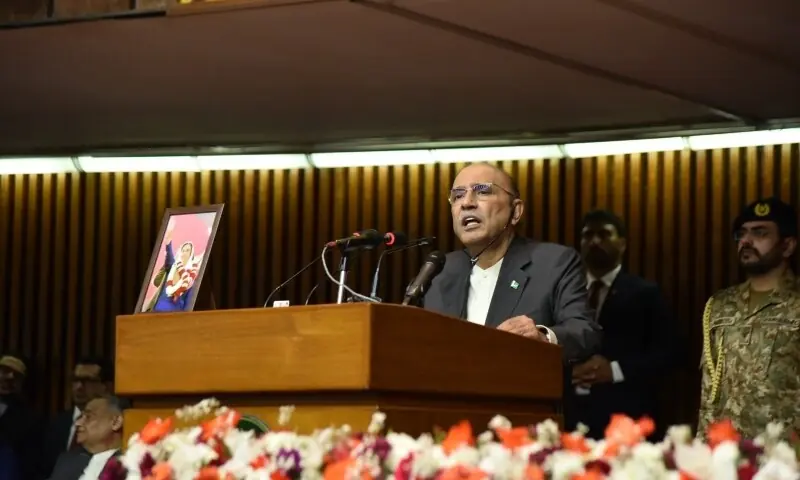
President Asif Ali Zardari on Monday addressed a joint sitting of Parliament amid a ruckus by members of the opposition, saying that Pakistan would not “allow any entity, domestic or foreign to use neighbouring territory to destabilise our peace”.
This was his ninth address to a joint session of Parliament in his capacity as president. His address was punctuated with sloganeering from the opposition, who chanted, “Go, Zardari, go” and “Khan ko reha karo (free Imran Khan)”.
At one point, the opposition gathered in front of the speaker’s dias and continued to raise slogans.
President Zardari began his address by saying that it was his “singular privilege” to address the house for the ninth time at the beginning of the new parliamentary year.
“Each such address is a reminder of the continuity of the democratic system and the responsibility we carry as representatives of the people of Pakistan,” he said.
“The past year has reminded us that the strength of our republic lies in its Constitution,” he said.
“As we gather here today, we stand on the foundation laid by those who shaped our national journey,” he said. He said that the founder of the nation, Mohammad Ali Jinnah, had envisoned a democratic state rooted in constitutionalism and the rule of law.
“The last time I was president, I unilaterally returned the powers given to the presidency back to the House of Parliament as envisioned in the 1973 Constitution, through the 18th Amendment,” he said.
“Today, the presidency stands as a symbol of unity … a bridge between federating units and a guardian of constitutional law,” he said.
‘Past 10 months have tested nation’
He further said that the past ten months had tested the nation in “profound and complex ways”. He said that when the country’s sovereignty was challenged, Pakistan responded with “strategic restraint and firm resolve”.
He said that confronted with “unprovoked attacks on both our borders one after the other”, the armed forces responded with professionalism and discipline.
Talking about Marka-i-Haq, he said that they turned India’s attack on the motherland into a strategic victory.
“On the western border, when the Taliban regime ramped up a long line of attacks, on the night of Feb 26, our security forces acted decisively,” he said.
“The political leadership stood united; the people stood resolute,” he said. He expressed gratitude to the armed forces for defending the country’s border.
“It is because of their vigilance, bravery and service that we are sitting here secure in our workplace and homes,” he said. He said that the sacrifices of the country’s armed forces and law enforcement agencies in both conflicts could not be reduced to mere numbers.
“We only see their actions on the media with pride. We don’t really see their blood and sweat and tears that go into their training and service. Each operation reflects planning, discipline and restraint. Each martyr represents a family that has borne the ultimate [sacrifice] for Pakistan’s stability,” he said.
He said that 2025 marked a turning point for Pakistan, defined by the resounding military victory in Marka-i-Haq.
He also talked about occupied Kashmir, saying that nobody in South Asia would be free or safe until the Kashmiris won their freedom. He said that India’s leaders had said they were preparing for another war.
“As a life-long advocate for peace, I would not recommend it. At the same time, I will also say that any aggressor should prepare for another humiliating defeat; make no mistake, we are ready for you. Move away from warfare to meaningful negotiation. That is the only path for regional security,” he said.
“Pakistan is a responsible nuclear state and understands the weight of that responsibility. At the same time, we are a state that defends itself when required. Our conduct reflects maturity, confidence and clarity of purpose,” he said.
‘Will not allow any entity to use neighbouring territory to destabilise peace’
He said that last week, when India began to amplify proxy operations via Afghanistan, the Taliban regime saw what Pakistan can do when pushed past the red line.
“Until that week, we had tried every possible form of diplomacy to prevent an outbreak of military response to terrorist incursions from Afghanistan,” he said.
He said that Article 51 of the United Nations charter gave Pakistan the right to defend its sovereignty. He said that Pakistan let both, India and Afghanistan, see a “fraction of our capabilities”.
He said that over the last three years, the country’s armed forces and law enforcement agencies had undertaken intelligence-based operations against Indian-sponsored terrorists.
“This is not a counterterrorism campaign the military is fighting alone. The entire nation stands united with its armed forces against cross-border terrorism,” he said.
“Our actions spelt out our limits for our tolerance for attacks from Afghanistan, particularly by Indian-sponsored Tehreek-i-Taliban Pakistan (TTP) and Balochistan Liberation Army (BLA) and their affiliates. Let me be clear: the soil of Pakistan is sacred. We will not allow any entity — domestic or foreign — to use neighbouring territory to destabilise our peace,” he said.
He highlighted a recent report by the United Nations Security Council’s monitoring team, saying that it described terrorist groups in Afghanistan as an extra-regional threat.
“This report warns that any other country could fall victim to another catastrophic attack if the issue is ignored. However, it is a sad fact that despite multiple diplomatic engagements by Pakistan and our friendly brother countries, the Afghan de facto regime continues to provide safe sanctuaries to a variety of terrorist groups, including Al-Qaeda, BLA and TTP,” he said.
“All promises they made in Doha, not to allow these terror groups to operate from Afghan soil, have been conveniently forgotten,” he said.
The president said that the Afghan Taliban regime needed to choose to dismantle terror groups.
“On our end, we have never treated the Afghan people as anything but kith and kin. We have never walked away from dialogue. The Afghan people need a break from endless wars. Don’t take away their choice for a future of prosperity connected to peace. I would urge them to stop being used by another country as a battlefield for their ambitions,” he said.
Instability in Middle East
Talking about the situation in the Middle East, he said Pakistan was deeply concerned at recent developments, saying the country had always sought to prevent unilateral attacks on any country.
“In this spirit, we strongly condemn the war being waged on Iran while negotiations were under way. We have reaffirmed our support for the sovereignty and territorial integrity of our brotherly nation,” he said.
At the same time, the president also condemned the attacks launched by Iran on brotherly nations in the Gulf region.
“The sooner stability returns to the region, the sooner the world can go back to the business of rebuilding lives and fractured trust. I urge the need to exercise maximum restraint, to uphold international law, and to respect the territorial integrity of all brotherly nations. To save the region from a deepening crisis, we urge negotiated solutions that choose peace and restraint,” he said.
India’s ‘water aggression’
At one point, the president said, “Sustainable regional peace requires dialogue and respect for international law. Water security has emerged as a strategic concern.”
He said that India’s attempts to manipulate river flows and engage in “water aggression” required careful, long-term planning.
“India’s illegal actions that place the Indus Waters Treaty in abeyance is plain and simple hydro-terrorism — a weaponisation of vital water flows to exert political leverage. This blatant disregard for international and humanitarian law not only jeopardises Pakistan’s agricultural economy but signals a dangerous escalation in India’s strategy to destabilise the region,” he said.
“Rivers symbolise life. International law does not permit the unilateral blockage of water. This is not merely a bilateral issue. The stability of the region also depends on a web of transboundary water-sharing practices. If one treaty is flouted, many others across other borders may also suffer the same fate. We will defend our water rights with unity, resolve, strength and legal clarity,” he said.
‘Equitable distribution of resources’
The president also said that he was constitutionally bound to safeguard the unity of the federation and Parliament.
“Provincial autonomy under the Constitution has strengthened participatory governance. A strong federation does not require centralisation. It requires coordination. Constitutional forums such as the Council of Common Interests must function effectively,” he said.
He further said that issues relating to natural resources, fiscal distribution, energy coordination and water management must be resolved through consultation.
“A functioning and harmonious federation also requires an efficient and equitable distribution of resources. I look forward to a just and equitable National Finance Commission Award in the coming year,” he said.
He said that Balochistan had a history of deprivation and deserved special attention.
“It deserves special attention. While we continue to dismantle insurgencies fueled by foreign proxies, we are equally focused on addressing the genuine social and economic grievances of the Baloch people. Our strategy is a hearts-and-minds campaign—ensuring that the dividends of our mineral wealth and blue economy reach the local population first. The people of Balochistan are and must remain full partners in Pakistan’s progress,” he said.
Talking about the economy, the president said that economic stability was inseparable from national security.
“I commend the government for steering the economy out of the virtual collapse it faced in the spring of 2022. Through steady stewardship, we have seen stability return in key indicators. But this is a first step on a journey to sustained, people-centric growth.
“Our salaried classes, pensioners, labourers and small traders, have endured a long night of hardship. The next phase must therefore focus on inclusive growth, jobs, and direct relief,” he said.
He further said that structural reform remained essential.
“Transparency in taxation and expenditure is fundamental to trust. The tax base must be widened. Technology and innovation are reshaping the global economy. Pakistan has reset policy frameworks for emerging sectors and digital assets.
“Sustainable platforms have been created to support responsible expansion in these areas. We cannot afford technological isolation. Perhaps no single bottleneck constrains our economic potential more than energy costs,” he said.
He further said that Pakistan could not afford to lag behind in moving toward clean energy.
“Energy reform is not a sectoral issue—it is the precondition for industrial revival. Agriculture anchors food security and rural livelihoods. Climate-resilient agriculture, water management and coordinated policy are strategic imperatives. Climate justice remains a principle we will continue to advocate internationally, but it must be visible at home too,” he said.
Toward the end of his address, the president said that security, economy and constitutional governance were interconnected pillars.
“Weakness in one undermines the others. Strength in one reinforces all. Pakistan has emerged from a period of acute pressure with restored credibility and renewed confidence,” he said.
“The responsibility now lies with us—legislators and policy executors—to ensure that gains are consolidated. As we begin this new parliamentary year, our priorities must remain clear: protect sovereignty, eliminate terrorism, build on economic stability towards growth and job-creation, strengthen federal harmony and deepen democratic governance,” he said.
“Let us preserve the unity displayed in moments of trial. Let us institutionalise reform. Let us ensure that macro-economic gains translate into household relief. Let us safeguard our borders while creating opportunities within,” he said.
Prime Minister Shehbaz Sharif was present for the president’s address. Further, the president’s son, PPP Chairman Bilawal Bhutto-Zardari, and daughter, MNA Aseefa Bhutto-Zardari, were also present.
Punjab Chief Minister Maryam Nawaz, Punjab Governor Haider Ali, Balochistan Chief Minister Sarfraz Bugti, Khyber Pakhtunkhwa Governor Faisal Karim Kundi, and Sindh Governor Kamran Tessori were also in attendance, in addition to National Assembly Opposition Leader Mehmood Khan Achakzai.
Additional input from Syed Irfan Raza