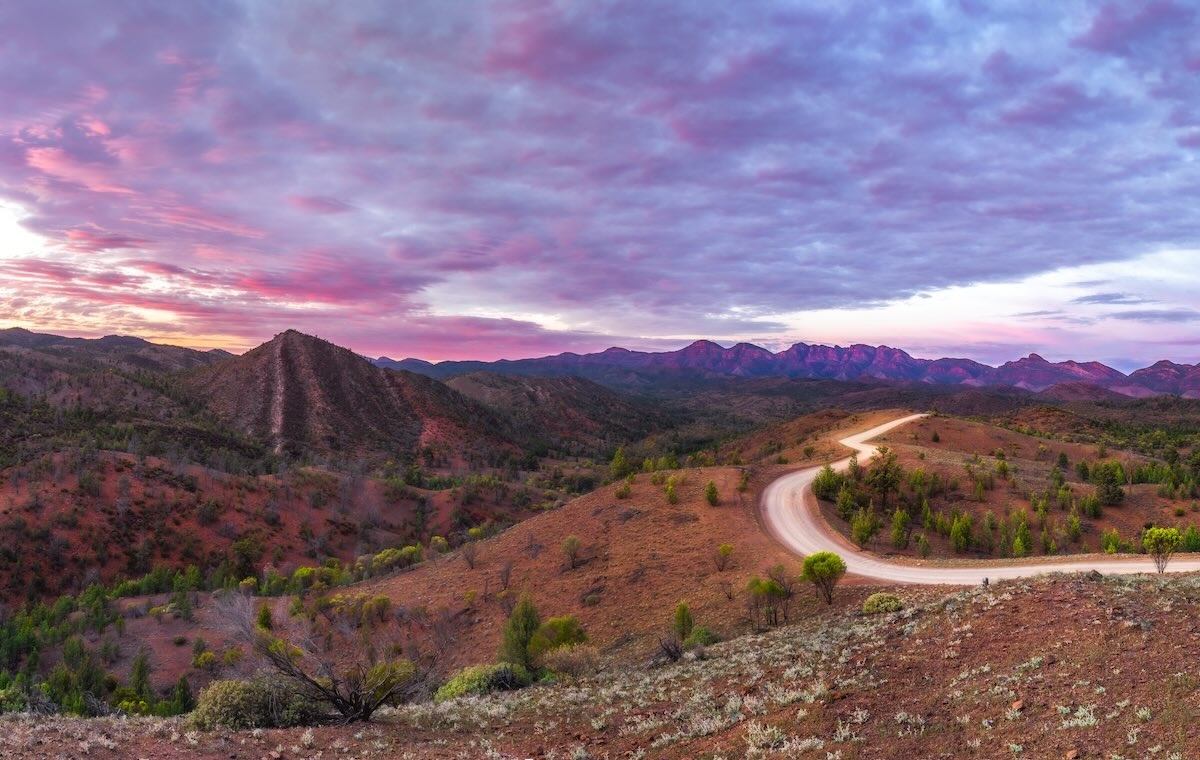
South Australia’s rugged outback could soon take its place among the world’s most celebrated natural landmarks, with the Flinders Ranges officially submitted for consideration for World Heritage listing.
The Federal Government has formally lodged the nomination with UNESCO’s World Heritage Centre in Paris, marking a significant milestone in a decade-long effort to secure international recognition for the region’s extraordinary geological, palaeontological and cultural importance. A decision could be made as early as 2027.
Spanning more than 58,000 hectares, the nominated area includes key sections of Ikara-Flinders Ranges National Park, Vulkathunha-Gammon Ranges National Park and Nilpena Ediacara National Park, alongside pastoral land including Arkaroola Wilderness Sanctuary.
What sets the Flinders Ranges apart is its unmatched record of early animal life. It is the only place on Earth where the continuous evolution of complex life between 672 and 510 million years ago can be observed across three geological periods — the Cryogenian, Ediacaran and Cambrian. Nilpena Ediacara National Park alone contains the world’s most comprehensive record of Ediacaran fossils, with more than 40 species identified.
Federal Environment Minister Murray Watt said the nomination reflects the site’s global importance. “The Albanese Government is proud to support the Flinders Ranges nomination to UNESCO’s World Heritage Centre,” he said. “A future World Heritage listing would mean protection under our national environment law, and international recognition at the highest level.
“The rugged landscape is one of the oldest living examples of life on Earth and is home to vulnerable native species like the Yellow-footed Rock Wallaby and the Western Quoll. We are committed to working in partnership with the South Australian Government and the Adnyamathanha people to ensure the Flinders Ranges is preserved for future generations as a place of outstanding universal value.”
The nomination dossier spans 368 pages, supported by nearly 4,000 pages of technical documentation. It also reflects deep Adnyamathanha cultural knowledge and connection to Country — a critical component of the submission.
UNESCO requires full consent from relevant First Nations communities, and in June, Adnyamathanha Common Law Holders formally endorsed the bid. Adnyamathanha Senior Elder Charles Jackson OAM said, “Adnyamathanha people have made a major contribution to this project through endorsement of the nomination and providing our cultural information so that we are front and centre on the world stage.
“This contribution is crucial and represents an example of working together during a time when there are lots of challenges for Aboriginal people. I’d like to give my personal congratulations to all Adnyamathanha people for coming together to work on this nomination.”
The SA Government has strengthened the bid by expanding protected areas, including a 26,000-hectare expansion of Nilpena Ediacara National Park and the acquisition of land from the Angorichina Pastoral Lease to add 4,500 hectares to Ikara-Flinders Ranges National Park. These expansions support threatened species such as the yellow-footed rock wallaby and thick-billed grasswren, while contributing to Australia’s commitment to protect 30 per cent of land by 2030.
South Australian Minister for Climate, Environment and Water Lucy Hood said, “This nomination is 10 years in the planning, 600 million years in the making.
“Gaining World Heritage status would rightly recognise the iconic tourist destination as a place you won’t find anywhere else. South Australia is in prime position to put the nation’s unique wonder on the globally renowned map.”
Already named the only Australian destination on this year’s Lonely Planet must-visit list, the Flinders Ranges could soon add another title — one that cements its place not just in South Australia’s story, but in the story of life on Earth.