Business
Vivtex and Nimbus Therapeutics are working with big pharma to develop the next wave of oral obesity treatments.
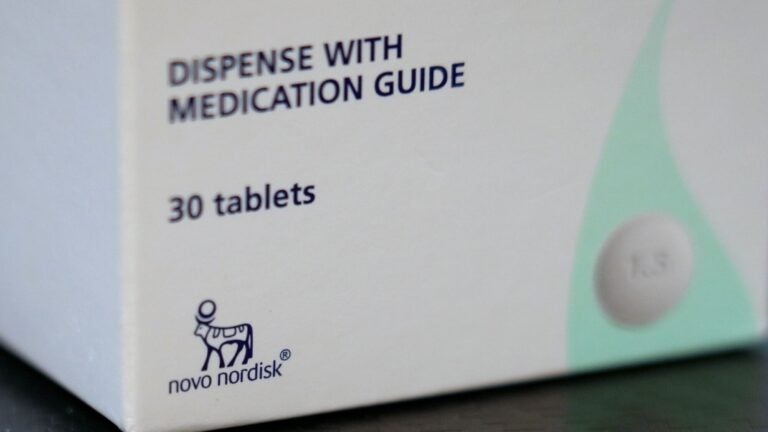
Wegovy weight loss pills Photographer: George Frey/Bloomberg
Two major pharmaceutical companies have tapped two Boston area startups in their bid to create the next big oral weight-loss drug, as demand for GLP-1 medications skyrockets.
Earlier this week, the Danish multinational pharmaceutical company Novo Nordisk announced a partnership with Cambridge-based Vivtex to develop the next generation of oral medicines for obesity and diabetes.
Vivtex is eligible to receive up to $2.1 billion in royalties on the net sales of future products.
MIT scientists founded the biotech company Vivtex, which created a high-tech system called a “GI tract on a chip” that uses robotics and AI to test how drugs move through the human digestive system.
The technology allows Vivtex to quickly test thousands of drug formulations and predict how they will be absorbed in people, much more accurately than traditional lab methods.
“Making biologics oral has been one of the most difficult challenges in drug delivery,” said Thomas von Erlach, Ph.D., CEO and co-founder of Vivtex, in a statement. “Partnering with Novo Nordisk allows us to apply our platform across important metabolic disease areas.”
Since early 2024, the company also partnered with Astellas Pharma, Orbis Medicines, Equillim and AI Proteins to develop new oral medicines and make treatments more convenient and effective for patients.
However, the global pharmaceutical corporation headquartered in Indiana, Eli Lilly, also recently announced a partnership with Boston-based Nimbus Therapeutics, potentially worth up to $1.3 billion. The two are not far behind in developing an oral obesity treatment.
Headquartered in South Boston, Nimbus Therapeutics is a biotech company that uses computer modeling and AI to design new drugs.
Nimbus is also developing several experimental medicines, including a cancer drug for certain tumors, a drug for inflammatory and autoimmune diseases, and other early-stage cancer programs.
“We are excited to collaborate with Lilly on another program, combining our discovery capabilities with their metabolic disease expertise to bring a much-needed new treatment to people with obesity and make a meaningful difference in their lives,” said Peter J. Tummino, Ph.D., president of Research and Development at Nimbus, in a statement.
Novo and Lilly are in a fierce race to bring the next GLP-1 drug to market. At the beginning of January, Novo announced that the Food and Drug Administration had approved its first and only oral GLP-1 for weight loss in adults.
In an effort to bring costs down as many health insurers stop coverage, the company is pricing the starting dose of Wegovy at $149 a month.
However, Lilly remains to have a strong hold on the injectable Zepbound for obesity and Mounjaro for diabetes, with revenue in the last few months of 2025 increasing 43% thanks to those two drugs alone.
The company is also trying to get to more consumers whose health insurance no longer covers the drug.
On Monday, the company launched a single pen containing one month’s worth of Zepbound doses, starting at $299 per month for the lowest-dose level, on LillyDirect, the company’s website.
Beth Treffeisen is a general assignment reporter for Boston.com, focusing on local news, crime, and business in the New England region.
Sign up for the Today newsletter
Get everything you need to know to start your day, delivered right to your inbox every morning.