Canadian Prime Minister Mark Carney’s arrival in India on Friday will mark a significant moment for the bilateral relationship that has gone through an arc of downs and ups over the last two-and-half years.
Carney will land in Mumbai and later visit New Delhi for talks with Prime Minister Narendra Modi, before wrapping up his trip on March 2.
Even a year back, such a visit would have been unthinkable. Bilateral ties unravelled in 2023 under Justin Trudeau over the killing of pro-Khalistani separatist Hardeep Nijjar. The unprecedented diplomatic crisis had political, economic and geopolitical consequences. The impact on the people-to-people ties, too, was immense.
After Carney took charge in early 2025, both the Canadian and Indian governments put in a tremendous amount of heavy-lifting to build back the relationship and shield it from the fallout of Trudeau’s Nijjar allegations. And as US President Donald Trump upends the world with his trade policies, this relationship assumes more importance than ever.
The bombshell
In September 2023, then prime minister Justin Trudeau dropped a bombshell allegation in the Canadian parliament, saying the Indian government could have had a hand in the June assasination of Khalistani separatist Nijjar in British Columbia province.
Trudeau said he had taken up the issue with Prime Minister Modi during his visit for the G20 Leaders’ Summit in September.
The Ministry of External Affairs called Trudeau’s accusation “absurd and motivated”. It said he had made similar allegations during his meeting with the PM, which had been “completely rejected”.
Story continues below this ad
The diplomatic escalation happened rapidly. Both sides expelled diplomats, closed down consulates and withdrew High Commissioners. These were particularly drastic steps, usually taken in situations such as wars and terrorist attacks.
Top Canadian officials — national security and intelligence advisor Nathalie Drouin and deputy minister of foreign affairs David Morrison — also linked India’s Home Minister, Amit Shah, to an alleged campaign of targeting Sikh separatists in Canada.
The Indian government responded sharply to the allegations and called Canada a “safe haven” for “terrorists, extremists and organised crime”. Such descriptions are usually reserved for Pakistan and Afghanistan, and it was rare for India to use them for a Western democracy.
The recovery
The needle began to move in January 2025, when Trudeau announced he would step down. Carney replaced Trudeau as prime minister in March and his Liberal party won the general election in May, cementing him in the role.
Story continues below this ad
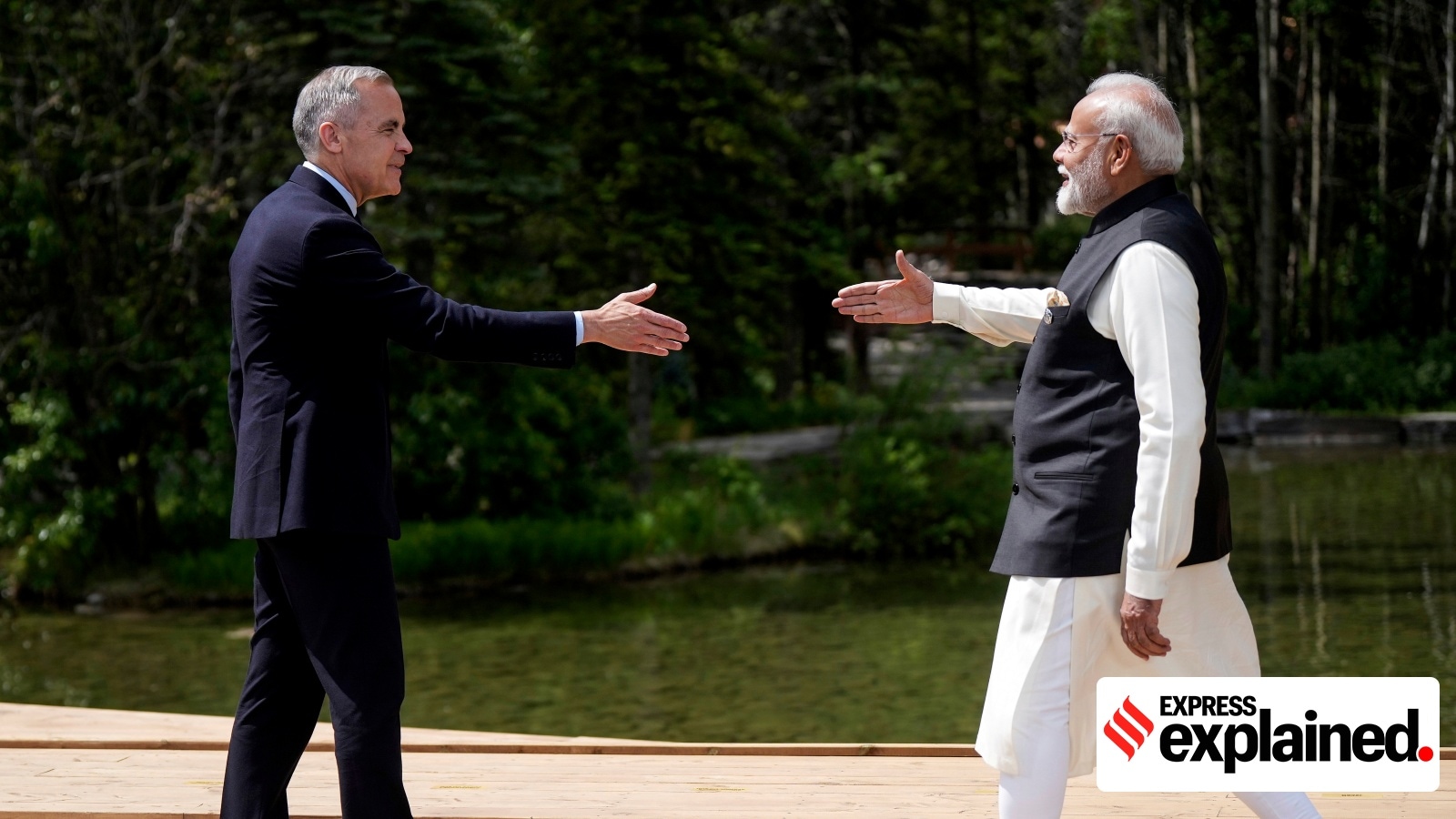
A former central banker, Carney was keen to reset ties with India, a major economic partner. He approached the Nijjar killing as a law enforcement and judicial issue that was best delinked from political and economic relations. So, he made the first move by inviting Modi to the G7 leaders’ outreach summit in June last year in Kananaskis, Canada.
Following a “positive” meeting, both leaders “agreed to take calibrated and constructive steps to restore stability” in their relationship, starting with the “early return of High Commissioners to each other’s capitals”. The thaw led to the reinstatement of envoys and diplomats, lifting of visa curbs, and reciprocal visits over the last eight months at the foreign minister and NSA level.
To firewall the relationship from the Nijjar investigation, both sides have created a separate framework under their National Security Advisors to discuss “transnational crimes”. This mechanism is specifically meant to address the concerns related to pro-Khalistani activities in Canada.
The pillars of the relationship
Notwithstanding the relatively brief strain in ties, India and Canada have typically enjoyed strong cooperation in sectors such as politics, business, investment and people-to-people relationships. Here’s a look at the pillars of cooperation and how the two governments are looking to build on them.
Story continues below this ad
Trade and economic ties
At last year’s G20 Leaders’ Summit, Canada and India agreed to formally launch negotiations for an ambitious Comprehensive Economic Partnership Agreement to double two-way trade to $70 billion by 2030. In 2024, India was Canada’s seventh-largest goods and services trading partner, with two-way trade at $30.8 billion.
India’s major exports to Canada are pharmaceutical products, machinery parts and mechanical appliances, iron and steel products, electronic goods, organic chemicals, jewelry, gems, textile and seafood. India’s major imports from Canada include pulses, fertilizers (potash) and minerals.
According to the Department for Promotion of Industry and Internal Trade, Canada is the 17th largest foreign investor in India. Its cumulative investment of $4.18 billion from April 2000 to June 2025 represented 0.56% of the total FDI inflows into India.
Security and defence
India and Canada have regularly engaged in dialogue and cooperation on global security issues, including counter-terrorism, cyber security and regional stability. The counter-terrorism engagement has largely taken place through the framework of the ‘Joint Working Group on Counter Terrorism’ set up in 1997. Both sides also enhanced security cooperation through another framework on ‘Countering Terrorism and Violent Extremism’ signed in February, 2018. Canada’s national security and intelligence advisor, Drouin, met India’s NSA, Ajit Doval, in New Delhi on 18 September, 2025. Doval visited Canada from 6-7 February, 2026 and met Canada’s Minister of Public Safety Gary Anandasangaree and Drouin.
Story continues below this ad
Energy
With Canada’s vast natural resources and India’s expanding energy demand, energy cooperation remains a key pillar of the bilateral relationship. The partnership encompasses both conventional and renewable sources, with Canada pitching itself as a reliable supplier of oil, gas, LNG, LPG, crude oil, and critical minerals.
Education
The education sector has significantly strengthened people-to-people ties between the two countries. Indian students represent the largest group of international students in Canada. More than 3.92 lakh Indian students were studying in Canada as of December 31, 2024. Both countries have long recognised the strategic significance of higher education and research. The educational ties include institutional linkages, joint research programs and academic mobility initiatives.
Diaspora
With over 1.8 million Indo-Canadians and approximately a million non-resident Indians, Canada is home to one of the largest and most vibrant Indian diasporas in the world. Indo-Canadians have had a profound impact across a wide range of sectors, and their influence continues to grow.
Diplomats who have dealt with Canada say pro-Khalistan elements are a small minority in the Canadian Sikh community and had hijacked the Trudeau government’s India policy. Estimates suggest that of the about 20 lakh Indian diaspora, only about eight lakh are Sikhs. Of them, Indian estimates say, only about 1% — 8,000-9,000 people — are pro-Khalistan radicals.
Story continues below this ad
But this small population of Khalistanis control 12-15 gurdwaras, where they generate funds and organise politically. The constituencies in which they have a say are mostly in Brampton in Ontario province, and Vancouver and Surrey in British Columbia.
Geopolitics
Canada is an important strategic partner for major western powers — it is part of the G7 grouping and shares the table with the US, UK, Germany, France, Italy, and Japan. It also shares intelligence with the Five Eyes grouping which also includes the US, the UK, Australia and New Zealand.
All these countries are also close strategic partners for India.
Last fall, on the margins of the G20 Leaders’ Summit, Canada, India and Australia entered into a new trilateral technology and innovation partnership to deepen strategic collaboration on critical and emerging technologies and drive further diversification of supply chains toward a secure, sustainable, and resilient future.
Story continues below this ad
Carney’s visit is expected to give a fillip to all these sectors and more, especially with Trump’s actions affecting Canada and India.