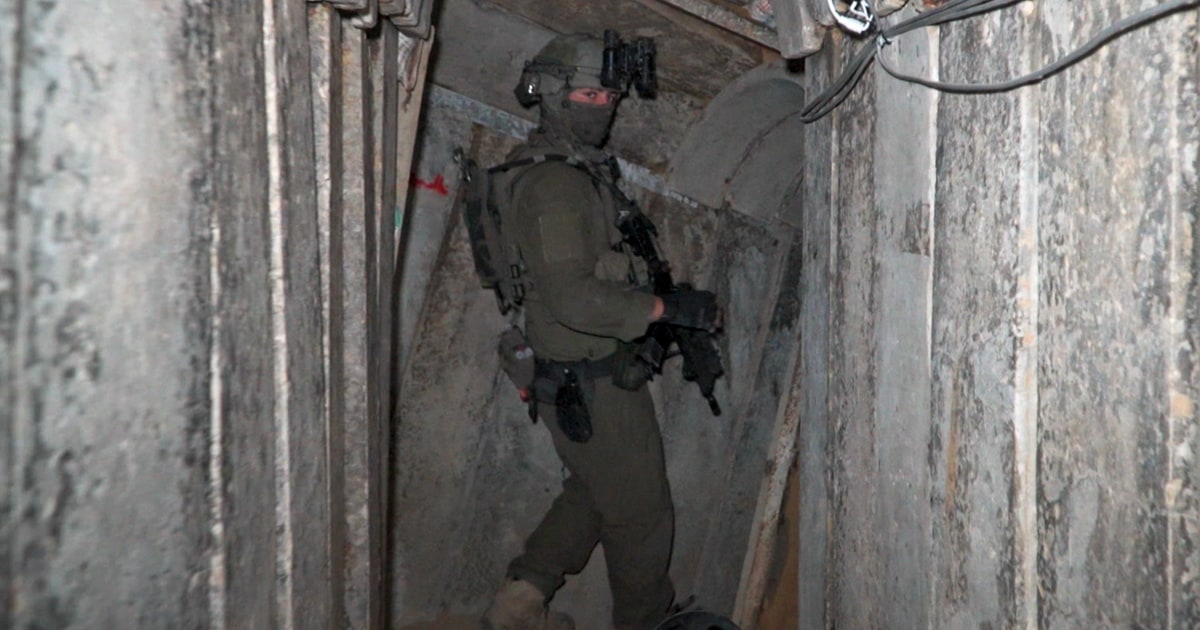
Crossing into the enclave, the perfectly paved streets and green farmland in Israel’s border region disappear, replaced by destruction and dirt roads as you enter northern Gaza and the largely destroyed Shujaiya neighborhood where the tunnel was located. Fairly close by, what sounded like gunshots could be heard at one point.
Lt. Col. Nadav Shoshani, a spokesperson for the IDF, said that it looked like some of the Hamas fighters brought their family members to hide out in the tunnel, a privilege they did not offer to the general population of Gaza above them as they came under attack. NBC News could not independently verify this claim.
Acknowledging it was an estimate, Shoshani said there could be anywhere between 300 and 600 miles of tunnels underneath the enclave. But it was hard to say because Israeli forces were still uncovering them.
“The more you search, the more you find things you didn’t know about,” he said, adding that his forces were “finding the tunnels and dismantling them,” as part of President Donald Trump’s peace plan for Gaza “so you can rebuild this area.” Reconstruction could not begin until they had been destroyed, he said.
Hamas was still present in Gaza and its fighters had not put down their weapons, a key stipulation in Trump’s plan, Shoshani said. “We won’t stop defending our people until they’ll put down their weapons,” he said, adding that they could be used to attack Israel again.
NBC News’ Chief Foreign Correspondent Richard Engel inside the tunnel on Monday. Angela Neil / NBC NewsA bathroom with a toilet and sink was found inside.Angela Neil / NBC News
No Palestinians were seen during the roughly two-hour visit as none of them live in the area, which sits to the east of the “yellow line,” which demarcates the parts of the enclave under Palestinian and Israeli control. Just over half of the territory is still run by the IDF.
On the other side, the remainder of the Palestinian population, which sat around 2.3 million before the Hamas-led attack on Oct. 7, 2023. Health officials in the enclave say more than 72,000 people have been killed in the Israeli military campaign, which began after Hamas launched multipronged attacks on Israel, killing 1,200 people and taking more than 240 people hostage.
Envisioned as a temporary boundary, the “yellow line” — which has been demarcated using yellow concrete blocks — has instead become a flashpoint, as some Palestinians who have approached it have been shot dead by Israeli forces.
A concrete block marking the “Yellow Line” drawn by the Israeli military. Bashar Taleb / AFP via Getty Images
Israeli forces have been accused of repeatedly crossing the boundary and moving the blocks inward, sowing confusion among Palestinians — which the IDF has repeatedly denied.
On the other side of the “yellow line” in Gaza City in a worn-out tent, Iman Khzeiq, 70, said Monday that she was hopeful that one day she would be able to return to Shujaiya with her six grandchildren, whom she now cares for on her own.
“Their father was killed,” she said in an interview while sitting in a wheelchair. “Now I am both mother and father to them.”
Khzeiq, who said she suffered from diabetes and high blood pressure, added that instead of going to school, the children spent their days searching for water and food. But she was determined to stay near their home “even if we live on the rubble.”