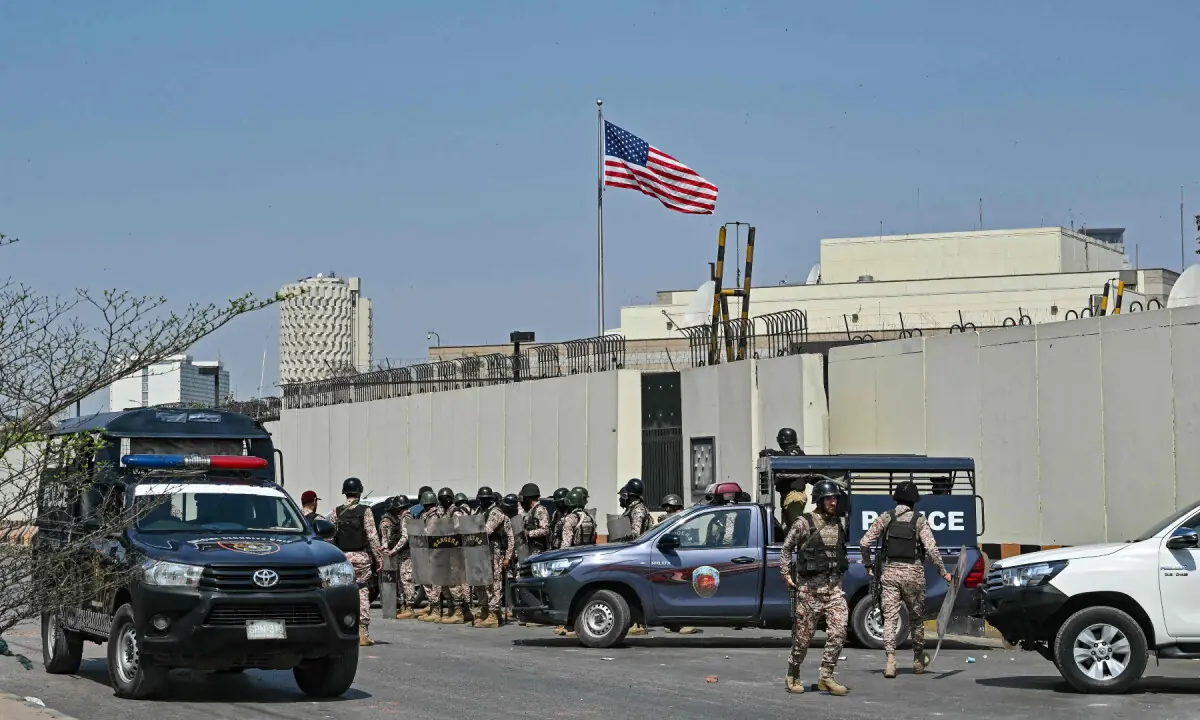
KARACHI/LAHORE/GILGIT/ISLAMABAD/DI KHAN: Ten people died in Karachi on Sunday, a hospital official said, after protesters clashed with law enforcement personnel near the US Consulate on Mai Kolachi Road, as protests erupted countrywide against the US-Israeli attacks on Iran.
The protests followed the assassination of Iran’s Supreme Leader Ayatollah Ali Khamenei in Saturday’s coordinated US-Israeli airstrikes on Tehran.
The situation warranted Interior Minister Mohsin Naqvi to issue an appeal, urging people to remain peaceful.
“Today is a sorrowful day for the entire Muslim ummah, Pakistan’s public and Iran’s public,” he said in a video statement.
Stating that every Pakistani citizen was as aggrieved as Iranians, Naqvi said, “My only request is that we all stand with you, but please do not take the law into your hands. You may protest but peacefully.”
Karachi clashes
Law enforcement personnel resorted to teargas shelling and baton-charge to control the situation at the US Consulate in Karachi.
According to a statement by Police Surgeon Dr Summaiya Syed listing all casualties, eight bodies were brought to Civil Hospital Karachi (CHK), while two succumbed to their injuries, taking the deaths in the US Consulate incident to 10.
A total of 62 people were injured near US Consulate, with 41 taken to CHK’S SMBBIT, seven taken to Jinnah Postgraduate Medical Centre (JPMC), eight taken to Aga Khan University Hospital (AKUH), and six taken to Fatimiyah Hospital.
Separately, eight persons injured during protests at Native Jetty and Numaish Chowrangi were brought to SMBBIT, while three wounded in a protest in Paposh Nagar were taken to JPMC.
This took the total number of people injured in protests across the metropolis to 73, Dr Syed’s statement said.
Out of them, 14 remained admitted in hospitals, while the rest were discharged after treatment, it added.
Of those admitted, six were in a critical condition — two at SMMBIT, two at AKUH and one at JPMC.
Dr Mohammad Sabir Memon, the executive director of Civil Hospital Karachi’s (CHK) SMBB Institute of Trauma, told Dawn that 9 had died and 34 were injured in the wake of protests near the consulate.
Dr Memon revised the death toll from 10 to nine, explaining that one deceased person was counted twice in the earlier figures.
Police surgeon Dr Summaiya Syed also confirmed to Dawn that nine people died as a result of the incident.
According to a list of casualties brought to CHK, the wounds to 34 injured and all the deceased resulted from “gunshots”.
Dr Syed said seven injured persons were each shifted to the Aga Khan University Hospital and the Fatimid Foundation, while the remaining were at CHK’s trauma centre.
In its statement, the US Embassy in Islamabad said: “We are monitoring reports of ongoing demonstrations at the US Consulates General in Karachi and Lahore, as well as calls for additional demonstrations at US Embassy Islamabad and Consulate General Peshawar.
“We advise US citizens in Pakistan to monitor local news and observe good personal security practices, including being aware of your surroundings, avoiding large crowds, and ensuring your STEP (Smart Traveller Enrollment Programme) registration is up to date.”
Speaking to Dawn earlier, Dr Syed said two injured policemen were among those brought to Jinnah Postgraduate Medical Centre (JPMC) for treatment.
The two policemen were injured by “hard and blunt instruments”, while “two protesters with firearm injuries” were also brought to JPMC, the police surgeon told Dawn.
Emotional scenes were witnessed outside the CHK’s mortuary, where bodies were brought for legal formalities.
In view of the arising security situation, roads near the US Consulate were closed off to traffic.
Later in the day, when authorities tried to place containers to block the roads near the US Consulate, protesters pelted stones, leading to more clashes.
This screengrab taken at around 8:30pm shows closed roads across Karachi on March 1, 2026. — Google Maps
Sindh govt forms JIT, CM orders ‘impartial probe’
In an official statement, shared by the information minister’s spokesperson Husain Mansoor, the Sindh government expressed “deep grief” over the loss of lives in the clash.
“The protesters entered after breaching the security cordon of the US Consulate and committed vandalism,” the statement said.
However, the government put the number of deaths at six, adding that “several” were injured.
It formed a high-level joint investigation team (JIT) to “impartially review all aspects of the incident”. The JIT will “assess the circumstances under which the incident occurred and what its causes were”.
The JIT will also determine “who was responsible” for the incident.
While the government affirmed the public’s constitutional right to protest, it stressed that “maintaining a peaceful environment was everyone’s shared responsibility”.
“Any kind of vandalism, violence or taking the law into your own hands is inappropriate,” it noted.
The government requested citizens to “express their emotions only in peaceful and legal ways”.
Citizens are urged to express their feelings only in peaceful and legal ways.
“The government wants to keep the situation under control,” the statement said, adding that while citizens had the right to peacefully protest, no one should take the law into their hands.
Police resort to shelling to disperse protesters outside the US Consulate in Karachi on March 1, 2026, following Iran Supreme Leader Ayatollah Ali Khamenei’s assassination. — Shakil Adil/ White Star
In his statement, Sindh Chief Minister Murad Ali Shah termed the incident “extremely tragic” and expressed his deep grief over Khamenei’s death.
“In this hour of grief, the people of Sindh stand in equal solidarity with Iran and all those who are mourning,” he said.
He directed that an impartial investigation be conducted into the US Consulate incident.
“At a time when the country is facing a war-like situation, it is inappropriate to sabotage peace and order,” CM Murad said.
He contacted various religious leaders, including Allama Shahenshah Naqvi, Allama Shabbir Maisami, and others, to urge them to ensure that public sentiments were controlled at all costs.
Allama Naqvi and others spoke about holding a majlis (gathering) at Numaish, the CM Office statement said, adding that Murad directed the administration and the police to provide full security for it.
CM Murad appealed to all religious scholars and people of different schools of thought to guide the public toward maintaining peace and order.
Expressing his deep sorrow over the loss of lives in the US Consulate incident, he said the government cannot allow anyone to take the law into their own hands.
In a video statement, Allama Naqvi termed the consulate clashes “painful” and urged the public to remain peaceful.
He noted that the Muslim community was saddened over Khamenei’s “martyrdom”, adding that people should voice their grief “keeping in mind the sorrow of Karbala”.
Sindh Home Minister Ziaul Hassan Lanjar sought immediate details about the situation from Karachi Additional Inspector General of Police (AIG) Azad Khan, a statement from his office said.
“No one will be allowed to take the law into their hands,” Lanjar was quoted as saying. He ordered that the security of sensitive installations be made more effective.
The minister further directed that alternative routes be determined to maintain the flow of traffic and that law enforcement agencies (LEAs) remain fully alert and monitor the situation closely.
“Action will be taken in accordance with the law against elements disturbing law and order,” Lanjar warned.
Meanwhile, the Sindh Rangers said it had deployed “heavy contingents of mobile vigilance teams” across the city in view of the prevailing security situation.
Rangers personnel stand guard at the Jinnah Bridge in Karachi on March 1. 2026. — via Sindh Rangers
Earlier in the day, Keamari Senior Superintendent of Police (SSP) Amjad Ahmed Shaikh gathered police contingents to strengthen security at sensitive locations.
At around 11am, Karachi Traffic Police said both sides of the road from Sultanabad Traffic Section towards Mai Kolachi were closed for traffic due to a protest.
Providing alternative routes, it said traffic from Jinnah Bridge was being sent towards I.I. Chundrigar Road, vehicles coming from Boat Basin were being U-turned from Mai Kolachi Phatak and sent back, and those coming from PIDC were being sent back from Park Cut.
The traffic police urged the public to call Traffic Helpline 1915 for alternative routes to avoid inconvenience. “Traffic police are present and managing the flow of traffic,” it added.
2 dead, dozens injured in Islamabad
At least two protesters died and over 30 were injured during clashes with law enforcement personnel near the Diplomatic Enclave, where people had gathered to protest the attacks on Iran.
The clashes came after the district administration had banned all kinds of gatherings under Section 144 of the Code of Criminal Procedure (CrPC).
According to sources at Polyclinic Hospital, as many as nine injured persons were brought there, but one of them succumbed to injuries.
Sources at the Pakistan Institute of Medical Sciences (Pims) said a body and 25 injured people were brought to the hospital. The injured included three police officials and two Rangers personnel.
Eight of those admitted to Pims and Polyclinic were in a critical condition.
Majlis Wahdat-i-Muslimeen (MWM) Spokesperson Hasnain Zaidi, speaking to Dawn, also said that at least two persons had died.
He claimed that as many as 15 protesters were taken into custody and taken to a police station. “We have started efforts to get them released,” he added.
Police resorted to heavy shelling near the Foreign Office building in an effort to stop the protesters from entering the Diplomatic Enclave. The police, backed by Rangers, succeeded in pushing the protesters back and out of the Red Zone.
Police resort to shelling to disperse protesters near Islamabad’s Red Zone on March 1, 2026. — Tanveer Shahzad/ White Star
In the late afternoon, thousands of people reached Aabpara Chowk to march towards the US Embassy for protests over Supreme Leader Khamenei’s assassination.
However, the march was stopped by the law enforcement agencies (LEAs) at Serena Chowk, where shelling was employed, resulting in multiple injuries.
Protesters also manhandled mediapersons, including cameramen and photographers, snatching their cameras and phones and deleting the pictures and videos.
Replying to a question earlier, Zaidi said that as the situation was becoming out of control, MWM chief Allama Raja Nasir reached the venue.
“Allama sahib, who is the leader of the opposition in the Senate, has been addressing the masses,” the MWM spokesperson added.
In an advisory at noon, the Islamabad police said all routes leading to the Red Zone, which houses important government buildings, had been closed.
The Islamabad district administration had banned all kinds of gatherings in the federal capital under Section 144 of the Code of Criminal Procedure (CrPC).
According to the district administration, all kinds of gatherings and assemblies would be considered unlawful under Section 144. It urged residents not to take part in any such gathering.
“Strict legal action will be taken in the case of any protest, demonstration or gathering,” the administration warned.
Earlier in the day, the interior minister visited various areas of Islamabad and reviewed the law and order situation in the Red Zone, Diplomatic Enclave, and other areas.
He inspected security arrangements and issued orders to ensure foolproof arrangements in the Diplomatic Enclave.
While noting that peaceful protest was everyone’s right, Naqvi said, “Mischief under the guise of protest cannot be allowed under any circumstances.”
He ordered that security arrangements must be complete and comprehensive in every respect, adding, “The law will take its course against disruption of daily life routines.”
Islamabad IG Ali Nasir Rizvi briefed the minister on the law and order situation. Chief Commissioner Muhammad Ali Randhawa, the deputy commissioner and other officials were also present on the occasion.
Section 144 imposed across Punjab; crowd dispersed outside US Consulate
Meanwhile, hundreds of activists from Majlis Wahdat-i-Muslimeen (MWM) assembled outside the US Consulate in Lahore at around 11am and attempted to force their way into the building, catching the police off guard.
However, a few policemen on routine duty around the consulate managed to push back the activists protesting the US-Israel attacks on Iran.
People gather to protest against the US and Israeli attacks on Iran, in Lahore on March 1, 2026. — Murtaza Ali / White Star
Some protesters told Dawn that one of their colleagues scaled the consulate’s boundary wall and was detained by security guards. By that time, police reinforcements had arrived, and a police inspector negotiated with consulate security to secure the protester’s release.
The protesters, including a large number of women, were carrying portraits of Khamenei and raising slogans against the US and Israel.
The MWM had scheduled the protest for 3pm, but its activists gathered at the venue much earlier.
Police cordoned off the area as activists of Tehreek-i-Bedari Ummat-i-Mustafa marched from the Punjab Assembly to join the demonstration at the consulate.
Meanwhile, the Punjab government imposed a ban on gatherings and sit-ins of four or more persons across the province for seven days.
Such assemblies were prohibited in “any public place, street, road, or open space except with the prior permission of the deputy commissioner concerned”, a notification by the Home Department said.
The ban did not apply to marriage ceremonies, funeral prayers, burial processions, courts of law, and “assemblies of officers/officials in government or semi-government offices for official duty”.
A complete ban was also imposed on the “carrying, display, or brandishing of all kinds of weapons (both licensed and unlicensed) or any destruction-causing material in public places” for seven days.
The notification clarified that the ban did not apply to personnel of LEAs and security agencies on official duty.
“This order shall come into force with immediate effect and shall remain in force for a period of seven (07) days, unless modified or withdrawn earlier,” the notification stated.
It stated: “Multiple credible threat alerts, regarding possible terrorist activities planned by hostile groups aimed at targeting minorities or Muslim scholars to trigger sectarian unrest, have been received.
“Assemblies, rallies, gatherings, sit-ins, processions, demonstrations, jalsas etc could present a convenient target for such terrorist attacks, and the possibility of an untoward incident cannot be ruled out.”
The Home Department noted there was a “strong apprehension that certain political, sectarian or anti-social elements may engage in activities, assemblies, gatherings or demonstrations that are likely to cause a breach of public peace, disturb the public order, and create a security risk for the general public and critical infrastructure”.
Curfew in Skardu after protests in GB
Separately, as demonstrations intensified across Gilgit-Baltistan after Khamenei’s assassination, curfew was imposed in the Skardu district.
Protesters set the offices in Gilgit and Skardu of the United Nations Military Observer Group in India and Pakistan (UNMOGIP) on fire.
They also set a school, the office of the superintendent of police, and the Agha Khan Rural Support Programme (AKRSP) office on fire during the protest.
Smoke billows after protesters set fire to a United Nations office during an anti-US and Israel protest in Skardu in Gilgit-Baltistan on March 1, 2026. — AFP
The GB police issued a statement saying that a curfew has been imposed in Skardu.
The statement said that the Pakistan Army had been called in under Section 245 of the Pakistan Penal Code (PPC), noting that UNMOGIP offices in Skardu and Gilgit were torched.
It said that no casualties were reported due to “timely intervention” by the police and administration.
According to the police, all foreign tourists in GB have been shifted to safe places.
Police requested the public to remain peaceful, saying, “It is everyone’s shared responsibility to thwart attempts to damage national property.”
Protesters march during an anti-US and Israel rally in Skardu in Gilgit-Baltistan on March 1, 2026. — AFP
Protesters blocked the Karakoram Highway (KKH) at multiple locations in Hunza, Nagar and Gilgit, holding pictures of Khamenei and chanting anti-American and anti-Israel slogans. They also staged a sit-in at Siachen Road in Kharmang.
Roads in Shigar and Ghanche also remained blocked, while the Baltistan Road has been blocked in Roundu and other areas. Inter-district roads also remained blocked.
Shops, markets, business markets and commercial activities remained suspended in Gilgit, Skardu, Hunza, Nagar, Shigar, Kharmang, Astore, and Ghanche, a Dawn correspondent reported.
Rallies in DI Khan, other KP areas
In Khyber Pakhtunkhwa, rallies in solidarity with Iran were staged in Dera Ismail Khan, Tank and Paharpur districts.
Hundreds of people staged a rally in DI Khan from Imamia Gate to Fawara Chowk, where participants held a gathering and offered prayers.
The rally, led by Allama Ramzan Tauqeer, was organised on the call of the Shia Ulema Council and other organisations.
Leaders and workers of various political and social groups joined the demonstration.
Among those present were Jamaat-i-Islami district president Manzar Masood Khattak, Advocate Zahid Mohibullah and Mian Allah Ditta Sajid of the Khaksar Tehreek, along with individuals belonging to different schools of thought.
Participants carried portraits of Ayatollah Khamenei and placards bearing protest slogans, while chants were raised against the US and Israel.
Speakers termed the death of Iran’s supreme leader a grave loss for the Muslim world and warned that such developments could escalate tensions in the region. They urged the international community to play its role in ensuring peace and stability.
People gather to stage a demonstration in solidarity with Iran in Dera Ismail Khan on Maarch 1, 2026. — via Irfan Mughal
Addressing the gathering, Allama Tauqeer said the Iranian people were not alone in what he described as a difficult time and that the people of Pakistan stood with them.
JI’s Khattak said any violation of a country’s sovereignty was against international law and could have serious consequences. Other speakers also emphasised the need for restraint, dialogue and regional peace.
According to the administration, the rally concluded peacefully and no untoward incident was reported.
Heavy security arrangements were made by the district police during the rally, with additional personnel deployed along the route and traffic diverted to alternative roads.
Similar protest rallies were also held in Tank, Paharpur and other adjoining areas. Local authorities said the demonstrations remained peaceful, with no reports of violence or disruption from any of the locations.
Additional input by Irfan Raza, Kalbe Ali