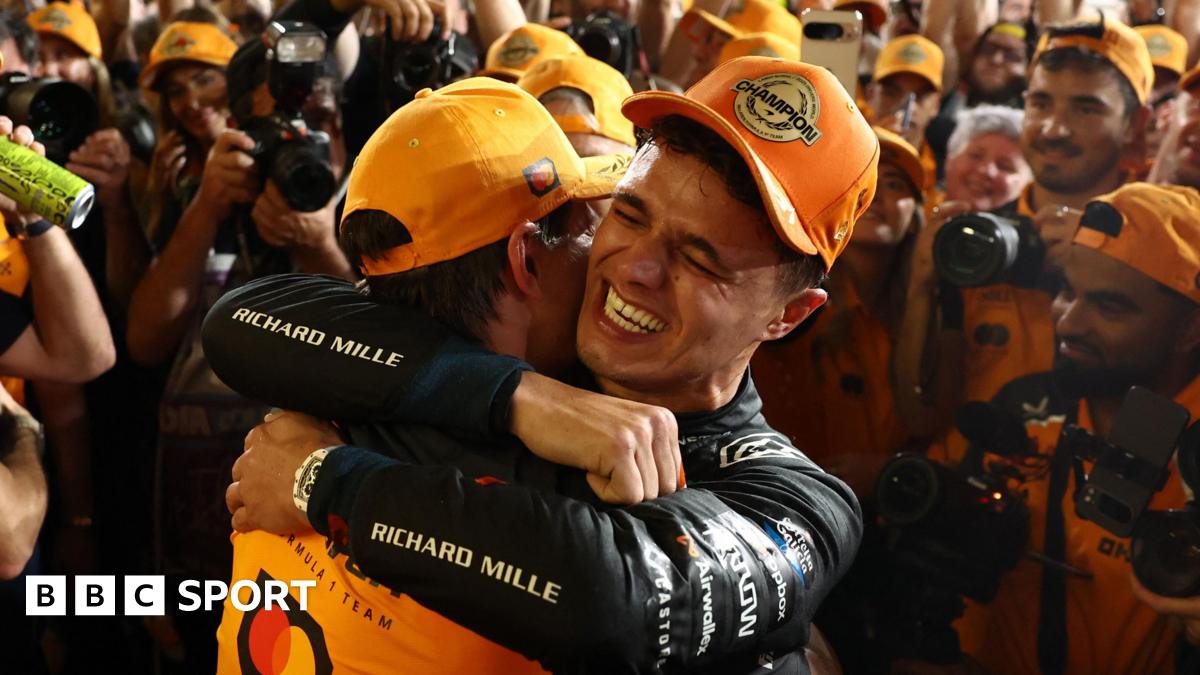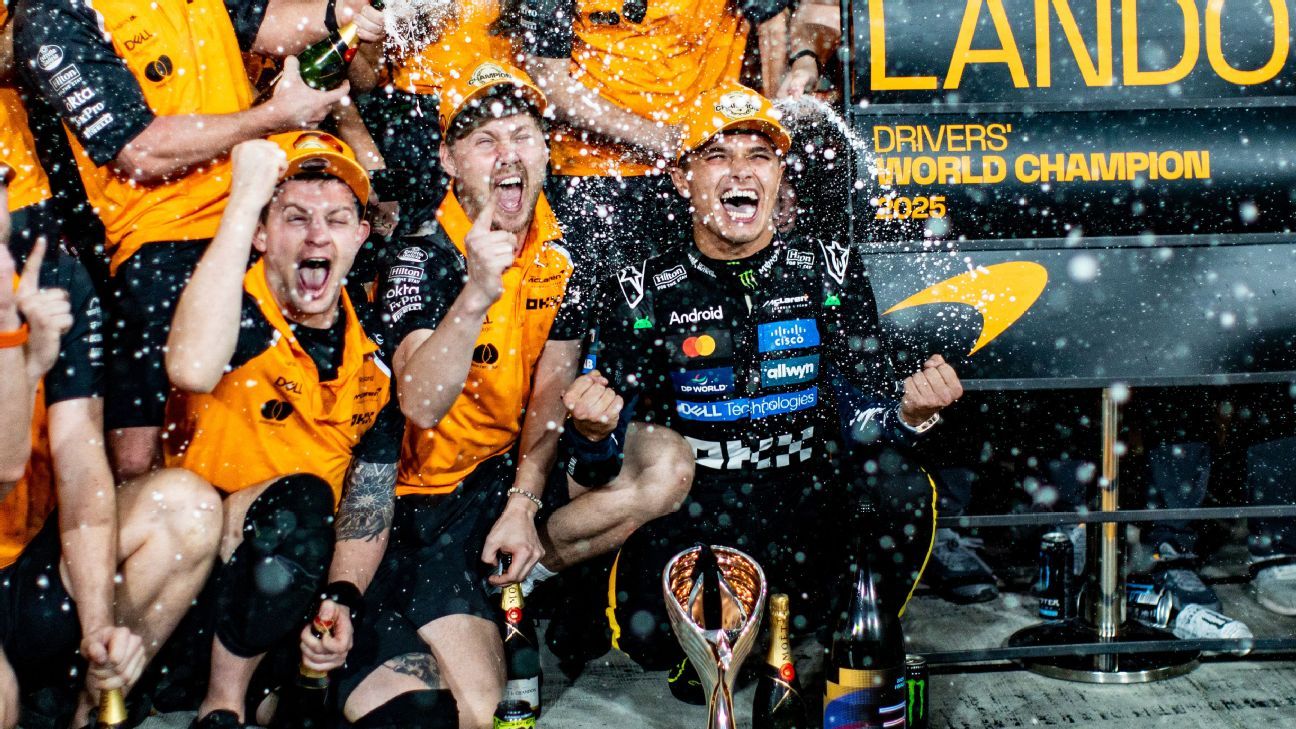
McLaren’s Lando Norris clinched his first world championship at the Abu Dhabi Grand Prix, the final race of the 2025 Formula 1 season.
His third-place finish was enough to beat previous champion Max Verstappen, and McLaren teammate Oscar Piastri.
It was by no means a simple thing. Norris’ season was a rollercoaster worthy of the type of Hollywood blockbuster F1 helped to make earlier this year — featuring personal struggles, a tense and, at times, difficult to understand dynamic at McLaren, as well as a Verstappen resurgence of legendary proportions.
It was a captivating season — one that ended Verstappen and Red Bull’s run of four straight drivers’ titles, the first for a McLaren driver since 2008. Here’s a look at the highs and the lows in his championship campaign.
Preseason favourite
Lando Norris said ‘we just focus on ourselves’ when asked whether McLaren are the favourites this season. Mark Sutton – Formula 1/Formula 1 via Getty Images
After winning their first constructors’ championship of the millennium in 2024, McLaren came into this season confident they could challenge for both titles — before cars had even been officially unveiled ahead of the season, many bookies had Norris as the overwhelming favourite over teammate Piastri, who had also enjoyed a breakout 2024 featuring a first F1 race win.
Norris was coming into his seventh season, went the logic, while Piastri was stepping into a title-worthy car for his third. Winter testing only reinforced the view that McLaren was the team to beat and in Melbourne’s season opener at the start of May the papaya-coloured cars underlined their advantage with a dominant front-row lockout — Norris outqualified Piastri by just 0.084s.
The race which followed was chaotic, with heavy rain and three safety cars, plus a trip across the gravel for both McLaren cars as they drove flat-out for the win. Norris managed to escape and keep the lead, holding off a charging Max Verstappen at the end, while Piastri spun and ended up finishing ninth in front of a dejected home crowd.
The gravel moment aside, it had been a controlled and measured statement drive to open the season. It seemed like Norris had avoided a major early scare. But trouble was ahead and he would not win again until May.
Norris falters as Piastri, Verstappen share wins
Editor’s Picks
2 Related
After such a strong start, the next five races would be chastening for the British driver. Piastri fought back from his bitterly disappointing home race with a win at the Chinese Grand Prix, finishing nine seconds ahead of Norris, before Verstappen claimed victory in Japan two weeks later after one of the great F1 qualifying laps of the modern era. Norris finished second ahead of Piastri to keep the championship lead.
The first signs of some problems with Norris’ form came at the next race in Bahrain, where he fluffed his crucial Q3 lap. Piastri took pole and the win, while Norris qualified sixth, which he could only improve to third in the race.
In Saudi Arabia the growing trend of their contrasting form continued, with Norris crashing out in Q3. Piastri would beat polesitter Verstappen in the race, while Norris settled for fourth. It meant he gave up the championship lead to Piastri for the first time — he would not get it back again until November.
Miami’s race in early May appeared to encapsulate the way the season was unfolding. Norris had qualified alongside polesitter Verstappen and went through the first sequence of corners wheel-to-wheel with the reigning world champion — the McLaren driver ran wide and by the time he rejoined the track, he was sixth.
Norris would later lament the difficulties of fighting Verstappen on track, saying the Dutchman gave the option of “crash or don’t pass”. The moment was another where he had appeared to come off second best against Verstappen, a theme which appeared to be irritating him. “What can I say? If I don’t go for it, people complain,” Norris said post-race about the opening lap incident. “If I go for it, people complain so you can’t win.”
Norris had to settle for second behind Piastri in Miami and second behind Verstappen at Imola.
Back on top
Photo by Jakub Porzycki/NurPhoto via Getty Images
After six races without a win, Norris got his title charge back on track around the Monaco principality he became a resident of in 2022.
As is often the case with F1’s famous street circuit, Norris did most of the hard work on Saturday, with a scintillating lap giving him his first pole since Melbourne. Norris turned in a flawless drive on the Sunday to close the gap to Piastri to three points.
Things flipped back around in Spain, with Piastri beating Norris to victory and then holding that order for the race itself to open the championship lead back to 10 points. But the Barcelona event was more memorable for what happened further back, with an incensed Verstappen slamming his car into Mercedes driver George Russell in a crazy moment of indiscipline behind the wheel.
The penalty Verstappen got dropped him down the order, turning a likely fourth-place finish into 10th — a loss of championship points the Red Bull driver would come to lament at the tail-end of the year.
Papaya blues
After a year and a half of the McLaren drivers inching closer and closer to on-track drama, it finally happened at Montreal’s June race.
For the first time that year, McLaren had found itself a long way off the pace, and Russell was fighting Verstappen and Mercedes teammate Kimi Antonelli for victory out in front. Norris was closing in on Piastri in the battle for fourth in the closing laps when the worst-case scenario happened — the British driver, drifting across the track as if to line up a move at Turn 1, clumsily drove into the back of Piastri’s car, eliminating him instantly.
Piastri continued on to take fourth, a free 12 points in the title fight. It was not quite the nuclear implosion the media had expected. Norris immediately diffused any chance of the moment turning things toxic behind the scenes by taking full accountability.
“It was all my mistake, I take full blame so I apologise to my whole team and to Oscar for attempting something like that,” he said afterwards. “There’s going for it like in the hairpin — a good, fair move — and there’s being stupid like I was at the end.”
To most observers it played into a growing reputation Norris was building for struggling in the high-pressure moments.
Bounceback
Rather than derail his season, the Canada collision and how readily he had accepted blame seemed to refocus Norris at the Austrian Grand Prix a fortnight later.
The Spielberg event would be thrilling, with McLaren commendably allowing their drivers to duke it out for victory, even with the memory of the Montreal race finish fresh in the mind. It very nearly backfired.
This time Norris was ahead, with Piastri right behind him for the first half of the race. The pair had a couple of thrilling wheel to wheel moments where Piastri would briefly get the lead, only for Norris to snatch it back. McLaren’s nerve held for 20 laps before Montreal 2.0 almost unfolded in front of them, only in reverse.
While fighting for the lead at Turn 4, Piastri locked up massively and avoided ploughing into the back of his teammate by a matter of inches. McLaren would feel the need to intervene here, with Piastri’s race engineer Tom Stallard telling him: “Feedback from the pit wall, the manoeuvre in Turn Four with the lock up was too marginal. We can’t do that again.” Piastri agreed and seemed to have no problem with the slap on the wrist.
“I thought it was a fair comment,” he said. “Locking up and missing the back of your teammate by not a lot is certainly pushing the boundaries. Even if I hadn’t been told anything, I didn’t think it was a wise decision to try that one again. So, yeah, a fair comment and nothing more than that.”
Home comforts
ANDREJ ISAKOVIC/AFP via Getty Images
The British Grand Prix would be dramatic for different reasons. Perhaps still stinging from how Norris had won his home race earlier in the year, Piastri appeared determined to deliver his teammate a defeat on British soil.
Verstappen took pole ahead of Piastri and Norris before rain hit ahead of the race. Piastri snatched the lead off Verstappen at Stowe corner following a virtual safety car period, building a big lead in the following laps. A full safety car period wiped that away before controversy reared its head — while preparing for the restart, Piastri was judged to have braked erratically down the Hangar Straight, which had forced Verstappen into evasive action.
The 10-second penalty for Piastri and a spin several corners later for Verstappen were manna from Heaven for Norris, who inherited a lead he would not relinquish.
Perhaps as a sign of things to come, Piastri wondered if his misfortune was enough to ask McLaren for a do-over. Running behind Norris and seething at the injustice of his penalty, Piastri asked over the radio if the team would let him have the lead back, assuming they shared his view the penalty was unfair. McLaren declined.
“I thought I would ask the question,” Piastri said after the race. “I knew what the answer was going to be before I asked … Lando didn’t do anything wrong. I don’t think it would have been particularly fair to have swapped, but I thought I would at least ask.”
Regardless, the moment would stick in Piastri’s head and would be key just a few months later. Norris would win at Silverstone, an achievement he called “amazing” and a “dream.”
Piastri would then beat Norris to victory in Belgium, before Norris beat Piastri to victory in Hungary ahead of the summer break. The pair went into August nine points apart. To most observers, the two remaining European races coming out of that break seemed absolutely crucial in their tense championship battle. They would be key for different reasons than anyone could have imagined.
18 points dropped
McLaren’s only race-ending failure of 2025 occurred on Norris’ car at the Dutch Grand Prix and appeared to signal a killer blow to his title chances. The heartbreak was audible in Norris’ voice as he sensed smoke in his cockpit on lap 65 and radioed his team to say “I’m out … failure.”
Up until that point of the race, the weekend had been a close-fought affair between the two McLaren drivers, with Piastri securing pole by 0.012 seconds ahead of Norris and retaining the lead at the start. Norris was running in second place when the failure — a chassis-related oil leak — occurred and forced him to pull to the side of the track where he climbed out of his car and sat dejected on a sand dune.
“[I] just want to go have a burger and go home,” he told reporters once he returned to the paddock. “It wasn’t my fault, so there’s nothing I can really do. It’s just not my weekend.” The retirement was undoubtedly a blow, leaving Norris 34 points adrift in the title chase, but also seemed to free him from the pressures of fighting for his first world championship and led to some of his best performances of his season.
Controversy in Monza
(Photo by Kym Illman/Getty Images)
McLaren’s desire to offer equal opportunities to its two drivers was put to the test at the Italian Grand Prix when the pit wall found itself in an awkward situation of its own making. Verstappen arrived at Monza with an updated version of his Red Bull, which unlocked a significant performance gain and made him untouchable on the circuit’s mix of long straights and slow chicanes.
Norris qualified 0.077 seconds off Verstappen but neither he nor Piastri, who started third, were a match for Verstappen in the race. The only chance McLaren had of snatching a victory was staying out longer than the Red Bull in the hope of a cheap pit stop under a safety car, but in doing so they were at risk of being undercut by Charles Leclerc behind.
The pit wall took the decision to switch the normal sequencing of pit stops and allow Piastri, in third, to pit before Norris in second.
Norris was onboard with the plan, but asked for a guarantee that Piastri would not gain a position over him as a result of the switch. Piastri’s pit stop went to plan and he emerged ahead of Leclerc, but when Norris came for his tyre change, a slow front saw him drop behind Piastri. As part of its Papaya Rules, McLaren and its drivers had agreed a slow pit stop was just part of racing and would not result in the team intervening to tell the drivers to swap positions.
But this situation was complicated by the change in the usual sequencing of the pit stops being reversed. With similarities to the 2024 Hungarian Grand Prix, at which Norris had been asked to give the position back after pitting before Piastri, the same was asked of Piastri in Monza and he reluctantly obliged. Although only three points split second and third, the call equated to a six-point swing between the two title protagonists and remained a point of controversy for the rest of the season.
Piastri and Norris throw away points in Baku
Piastri has admitted recently that the events of Monza were still playing on his mind when he arrived in Baku for the Azerbaijan Grand Prix. That might go some way to explaining the worst race weekend of his F1 career in which he crashed in qualifying, jumped the start and then crashed on the opening lap.
The door was wide open for Norris to capitalize on his teammate’s mistakes, but on the tricky street circuit he could only recoup six points with a seventh place finish to narrow the gap to Piastri to 25 points in the standings. Verstappen, meanwhile, took the victory and closed his own gap to Piastri to 69 points.
More internal conflict in Singapore
On arrival in Singapore, Piastri looked closer to his old self, but McLaren was once again facing competition from its rivals. George Russell’s Mercedes was the class of the field and secured pole position, while McLaren had to settle for Piastri in third on the grid and Norris, who touched the wall in qualifying, in fifth. With his situation looking increasingly desperate, Norris went on the attack in the opening corners of the race and barged past Piastri for third place after making slight contact with the rear of Verstappen.
Piastri felt his teammate’s move broke the fundamental Papaya Rule of no contact, and made his thoughts clear over team radio before he was forced to settle for fourth place behind Norris. Although the team didn’t act on the contact between its drivers during the race, it reviewed the first lap incident ahead of the next round in Austin and imposed unnamed “consequences” on Norris.
The threat of Verstappen emerges
Although McLaren had been fully aware of the threat of Verstappen for several rounds, alarm bells started ringing in Austin. The situation was not helped by both McLarens being eliminated from the sprint race on the opening lap when Piastri attempted an optimistic move to pass his teammate and triggered a multi-car collision.
Norris finished second to Verstappen in the grand prix while Piastri, unable to maximise the performance of his car on a bumpy, high-speed circuit, struggled and took fifth. The result tightened the championship fight once more, with Norris now 14 points off Piastri and the in-form Verstappen 40 points adrift.
Norris takes control
Victories in Mexico and Brazil (including a sprint race victory in Sao Paulo) propelled Norris to the top of the standings for the first time since April and made him the clear favourite heading into the final three races. Piastri, meanwhile, struggled for form, losing the lead of the championship in Mexico and falling 24 points adrift after the Brazil weekend.
Despite struggles with his car, Verstappen salvaged two third place finishes at the two races, but for the first time all year the championship looked like Norris’ to lose.
Double zero in Vegas
A second-place finish on the road appeared to put the title within easy reach of Norris in Las Vegas, but three hours after the race he and Piastri were disqualified from the results.
Excessive wear to the planks on the two cars — caused by unexpected porpoising during the race — meant both drivers were removed from the results by the stewards. The decision meant the points gap between the McLaren teammates remained at 24, but also invited Verstappen, who took a dominant win, into the fight on equal points with Piastri ahead of Qatar.
Handing Verstappen more momentum
Mario Renzi – Formula 1/Formula 1 via Getty Images
At the following race a week later in Qatar, McLaren opted not to bring Norris and Piastri in for fresh tires under a safety car. Every other team pitted.
That strategy call handed Verstappen the win and left Piastri “speechless” in second, with Norris fourth.
Suddenly, Verstappen was just 12 points off an astonishing title.
Clinching the title
Giuseppe CACACE / AFP via Getty Images
After a rollercoaster campaign, Norris was about as assured as he could have been in Abu Dhabi — although there were some scares.
After qualifying second, the Brit was overtaken by Piastri on the first lap and then had to fend off Ferrari’s Leclerc throughout the race. He was also involved in a touch of controversy, noted by stewards for an off-track pass on Yuki Tsunoda.
But Norris eventually saw it home, beating Verstappen — who claimed his sixth win in nine — by just two points.
The ultimate dream was complete.