Transportation
Routes 23, 28, and 29 will remain fare-free through December.
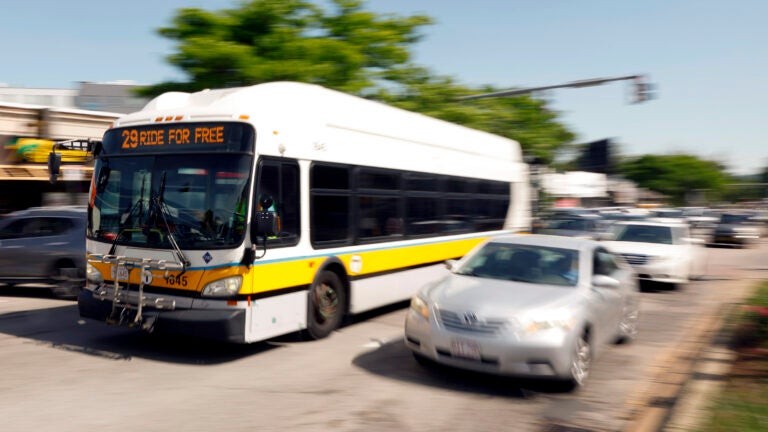
The MBTA bus on route 29, which is fare-free under a city program, travels north on Blue Hill avenue near Mattapan Square during the afternoon rush hour. Danielle Parhizkaran/Globe Staff
Riders on MBTA bus routes 23, 28, and 29 will continue to ride free through the end of 2026 as an extension of Boston’s fare-free bus program, which has been under pilot for four years, city officials announced.
The routes were originally scheduled to remain fare-free through June. But after ridership on the three routes grew faster than anywhere else in the MBTA bus system, Boston and the MBTA agreed to extend the program through December, the City of Boston said in a press release.
“Fare-free buses are delivering results for residents — saving commuters money, easing traffic, and growing our economy by connecting Bostonians to work, fun, and family,” Mayor Michelle Wu said in the release. “We’re proud to partner with the MBTA to extend this successful program as we continue building a more reliable, accessible, and affordable transportation system across Boston.”
Since the beginning of 2026, riders have taken nearly 23,000 fare-free trips each weekday on the three routes, according to the city. Allowing riders to board the buses through all doors has reduced “dwell times” at bus stops by about 20 percent, officials said.
The fare-free initiative began in 2021 on Route 28, one of the MBTA’s busiest routes. The pilot was designed to test whether eliminating fares could make transit more affordable, speed up boarding, improve rider experience, and help rebuild ridership following the COVID-19 pandemic, according to city officials.
After fares were eliminated that year, Route 28 ridership rebounded to more than 90 percent of pre-pandemic levels, reaching more than 12,000 daily riders, according to city data.
Building on those results, Boston expanded the program to Routes 23 and 29 in March 2022. The routes serve neighborhoods in Roxbury, Dorchester, and Mattapan, including communities along Blue Hill Avenue.
City evaluations found that the program reduced transportation costs for many riders.
According to a mid-program report, 26 percent of riders reported saving at least $20 per month, with savings often going toward groceries, emergency funds, and other household expenses. The city also found that ridership on the fare-free routes grew faster than the broader MBTA bus network while maintaining reliable service.
“I’m glad to support the extension of the City’s Fare-Free Program, ensuring that the City’s dollars can go farther for their residents,” MBTA General Manager and CEO Phillip Eng said. “The MBTA is happy to collaborate with our municipal partners on efforts that make public transit easier to use and more widely available.”
Supporters of the program said the extension will continue to benefit riders who depend on bus service every day.
“The continued growth in use of the routes along Blue Hill Ave show how vital the need is for fare free service for more than 40,000 daily transit users each day,” State Rep. Russell Holmes said.
Jeff Rosenblum, interim executive director of the transit-focused nonprofit LiveableStreets, said the fare-free initiative has yielded favorable results for commuters, noting that passengers are reporting lower stress levels and increased flexibility in their budgets for essentials like groceries.
“More people are choosing transit over driving, and some have started riding the bus for the first time because it’s free,” he added.
Transit advocates also pointed to broader benefits beyond cost savings. Caitlin Allen-Connelly, executive director of TransitMatter, said extending the program particularly supports the BIPOC communities that rely heavily on Route 28, which saw a 38 percent ridership surge.
“[The extended program] provides further incentive for the City of Boston to continue to advance transit priority projects to keep buses moving, ensuring transit is both affordable and dependable,” Allen-Connelly said.
The fare-free initiative relies on $8 million in federal American Rescue Plan Act funding to compensate the MBTA for the absence of fare income. The extension is further supported by cost savings from the MBTA’s Income-Eligible Reduced Fare plan, which launched in September 2024 and lowered transit costs for qualifying riders across the region, according to officials.
The city said it will spend the summer and fall evaluating options for the future of the fare-free initiative beyond this year.
The city also highlighted the program’s role in reducing transportation-related emissions by encouraging more residents to use public transit. Transportation accounts for nearly 30 percent of Boston’s greenhouse gas emissions, and city officials have identified increased transit use as a key component of their climate strategy.
“Extending the fare free bus program is an important step towards our climate goals,” Boston’s Chief Climate Officer Brian Swett said. “Making bus trips free and fast will continue to boost bus ridership, which will ease congestion and lower emissions for our region.”
Sign up for the Today newsletter
Get everything you need to know to start your day, delivered right to your inbox every morning.