In Rajasthan’s Sirohi district, mornings begin early. By the time the sun stretches across the rocky fields, women have already finished milking, tied up their cattle, and begun walking towards the nearest collection point with steel cans balanced on their hips.
Among them is Gokri Devi, a resident of Khambal village, who has been supplying milk to the Asha Mahila Milk Producer Organisation for seven years now.
Gokri Devi remembers the older days vividly, and many of those mornings used to bring anxiety. “Pehle doodh jaldi nahi puachta centre toh garmi mein kharab ho jaata tha and humein nuksaan hota tha,” she recalls.
“Earlier, the long wait for milk to chill down and reach bulk centre would spoil the milk quickly in the heat, and we’d suffer losses,” recalls Laxman Ram, a milk collection agent from Khambal village. “Now that the chiller, locally known as MilkoChill units, has come in, the milk stays fresh. The quality has improved more than ever.”
Laxman is one of the 10 sahayaks (operators) in Sirohi district whose households recently received solar-powered instant milk chillers through the dairy cooperative and WWF India.
With a combined capacity to chill 5,000 litres of milk per day using 33.5 kWp of solar power, these decentralised, solar-driven chillers are quietly transforming how milk is collected, stored, and transported in the region.
A woman-led dairy cooperative growing against the odds
Asha Mahila began in 2016, with just 11 women members, but it has since grown into an organisation of 50,000 women across 1,100 villages in 10 districts in Rajasthan, collecting over 1.5 lakh litres of milk daily. It was incorporated in Pali, Rajasthan on 21 March 2016 as a Producer Company under Part IXA of the Companies Act, 1956 with the financial support of DHANII (Dairy Health and Nutrition Initiative of India Foundation), Tata Trusts Dairy Mission and Technical support of NDDB Dairy Services to provide livelihood to rural women.
Despite this impressive growth, keeping the milk fresh posed a formidable challenge. Traditionally, milk was collected in metallic cans from village households and transported over long distances to the cooperative’s bulk collection centres. In the peak summer months, this often led to a rise in bacterial count, making milk unsuitable for premium products like paneer, curd, or sweets.
Asha Mahila began in 2016, with just 11 women members, but it has since grown into a cooperative of 50,000 women across 1,100 villages, collecting over 1.5 lakh litres of milk daily.
To understand the urgency of intervention, one must first grasp the geography of the problem. Asha Mahila’s model is built on Milk Pooling Points (MPPs) — village-level centres run by local sahayaks (operators) like Laxman Ram. Women bring their milk here for testing and pooling. From hundreds of such MPPs, insulated vans run through rugged terrain to larger MCC (Milk Chilling Centre) or BMC (Bulk Milk Cooler) plants.
In summer, getting milk to the plant is a race against time. Fresh milk comes out at around 35°C, but in metal cans, under 45–50°C, bacterial counts explode, rapidly degrading milk’s quality.
“Our main quality test, the Methylene Blue Reduction Test (MBRT), would fall sharply,” explains Drakshi Choudhary, dairy technologist and quality control executive at Asha Mahila. “A longer MBRT means better quality, but we were losing that even before the milk reached the central chilling plant.”
The existing solution of grid-powered bulk chillers was often crippled by the region’s unreliable electricity supply, forcing operators to resort to expensive, polluting diesel generators. The economic and environmental costs were unsustainable.
A solar solution takes shape
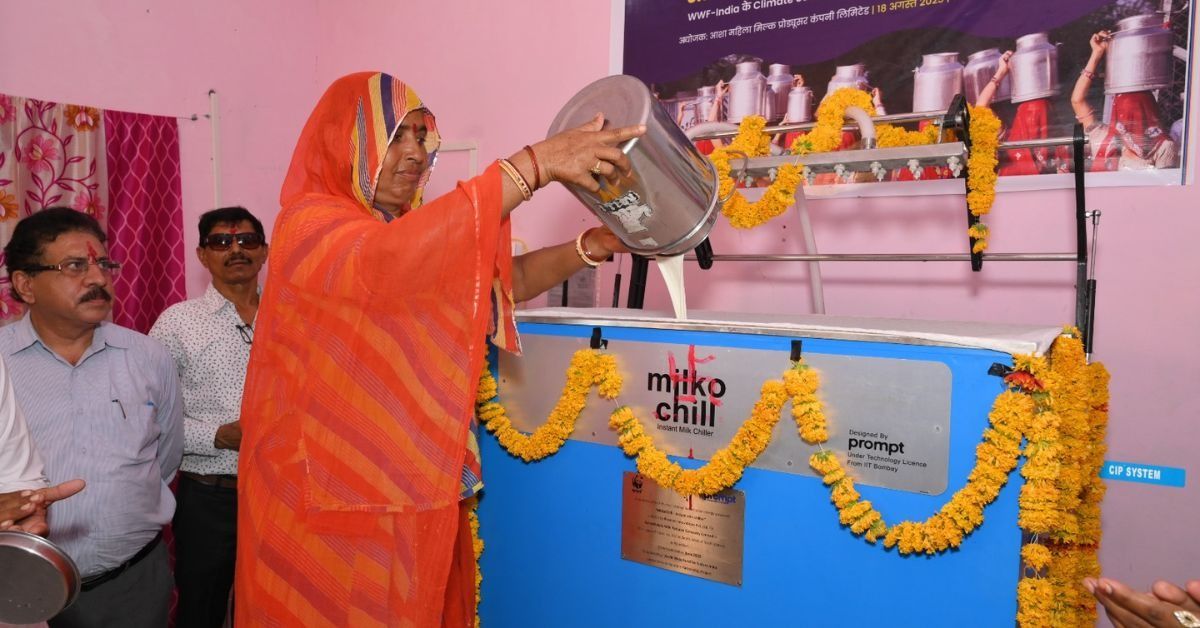
The breakthrough came through a collaboration with WWF India, which supported the installation of 10 solar-powered instant chillers in the Sirohi district. These chillers are compact yet technologically effective.
The chillers, each with a 500-litre capacity, are fitted with thermopacks and a 3.5 kW solar rooftop; the system freezes ice, which dissipates over three to four hours, reducing the milk temperature to around 4–6°C immediately after collection.
“The technology is simple but effective,” says Head-PIB (Producer Institution Building & Quality) Shiv Kumar Tomar. “Milk is collected in the morning and evening, passed through the thermopacks, and its temperature drops quickly. This prevents rejection due to heat, improves shelf life, and ensures women members receive the income they deserve.”
The chillers, each with a 500-litre capacity, are fitted with thermopacks and a 3.5 kW solar rooftop and helps in reducing the milk temperature to around 4–6°C immediately after collection.
However, even a compact technology requires substantial investment and behavioural change.
WWF initially supported 100% of the capital expenditure (CAPEX) required for the instant chiller units themselves. Each chiller unit, with a 500-litre capacity and a 3.5 kW solar rooftop system, costs approximately Rs 6.5 lakh.
However, the farmers (beneficiaries) were required to invest in the necessary civil infrastructure, which included constructing a 10×10 feet room with an RCC roof to house the unit and accommodate the solar panels, as well as securing a grid electricity connection for backup and future net metering.
Asha Mahila played a crucial role in convincing and mobilising 10 eager farmers to make these complementary investments.
“It took three to four months to convince a set of farmers,” Shiv recalls. “We took them to already installed units so they could see firsthand how it functions. Once they understood, their initial apprehensions turned into enthusiasm.”
Furthermore, Asha Mahila supports and facilitates the maintenance and service support for the installed machines through the technology supplier, ensuring their long-term operational sustainability.
Each chiller unit, with a 500-litre capacity and a 3.5 kW solar rooftop system, costs approximately Rs 6.5 lakh.
From WWF’s perspective, the Asha Mahila model was particularly compelling. Vishal Dev, Project Coordinator at WWF India, explains: “Asha Mahila is women-owned and professionally run, which made it an ideal partner for piloting this intervention. The uniqueness here is the ownership structure — women are both equity holders and decision-makers. Their willingness to try new technology and implement solutions at the grassroots level was key.”
A woman-led model
For Narsa Kunwar, Chairman of Asha, the transformation is both structural and social. She joined the cooperative three years ago, after years of dealing with middlemen who hardly paid women any money. Payments were irregular, cash-based, and often controlled by men in the household. Joining Asha changed everything.
“As soon as we saw the 10-day direct payment in our accounts with a confirmation SMS on the phone, we realised this system is different,” she recalls, stating direct deposits into women’s bank accounts have shifted household dynamics.
“Earlier, when a woman received money, she would give it to the man in the house. Now, the money comes into the woman’s account… and the man asks her for it,” she adds with a pride evident in her voice.
Beyond financial autonomy, Asha reinforces empowerment through governance. Ownership certificates are issued in women’s names. Village committees (VCG, MRG) are women-led, and board members must have completed high school. Regular meetings and training sessions have built confidence, cattle management skills and support services, and financial awareness.
Women who never left their homes now attend annual workshops, speak publicly, manage their own bank accounts.
Asha also extends its impact beyond dairy. The Asha Didi Rural Market provides women farmers access to agricultural and livestock products — from feed supplements and minerals to tools — all in one location. Ten markets exist today, with plans to cover every 25–30 villages, linking empowerment, entrepreneurship, and economic opportunity.
Narsha has witnessed transformations she never imagined possible in her village. Women who never left their homes now attend annual workshops, speak publicly, manage accounts, and routinely interact with banks.
The Paris moment
The change became real for Narsha when she travelled abroad — something unimaginable for a rural woman in her community.
She represented Asha in Paris, receiving an international award for the solar milk cooling initiative. The moment stayed with her not because of the recognition, but because it expanded the horizon of what rural women could aspire to.
“Women in our village never thought of stepping outside. Going to Paris showed them we can stand anywhere if we work together,” she says.
Asha received an international award for the solar milk cooling initiative in Paris.
Later, at a government event in Delhi, she shared a message that has since become her signature line:
“Save your daughter, educate your daughter-in-law, and move forward.” She repeats it in every village meeting now.
Cooling milk, warming futures
By August 2023, 10 of these solar sentinels were operational. The change they ushered in was immediate and profound.
“Earlier, if a milk transport vehicle was delayed or if a road was blocked, milk quality could deteriorate rapidly,” Shiv explains. “Now, even if there’s a delay of a few hours, the milk remains at the right temperature. It’s a game-changer for the farmers and the cooperative.”
For Laxman Ram, the morning anxiety has dissolved. “Now, with the chiller, our milk doesn’t spoil,” he states, the relief still fresh in his voice. The technical data validates his experience. The MBRT for milk from these villages improved by 40 to 50 percent, stating a dramatic leap in quality.
The solar-powered chillers reduce dependency on electricity or diesel generators, aligning with environmental sustainability goals.
The impact rippled out. Lasa Ram, another operator from Velangari, highlights the gift of time. “Women can deliver milk with more flexibility. They got an extra half-hour in the morning,” he says, noting how this small window eases the intense pressure of the women’s daily routines — managing livestock, households, and children.
There is a palpable pride, too. Laxman Ram shares that his centre has become a local exemplar. “People from other centres come to see how we do our business,” he says.
Strengthening India’s cold chain from the ground up
Beyond preserving milk, the solar-powered chillers reduce dependency on electricity or diesel generators, aligning with environmental sustainability goals. “Using solar instead of diesel cuts costs, reduces emissions, and demonstrates the economic viability of renewable energy at the village level,” Vishal adds.
Technically, each 500-litre unit works by freezing ice in thermopacks connected to a battery system. Milk flows through capillaries in the unit, allowing the chilled packs to absorb heat efficiently. The process maintains milk at safe temperatures for several hours, which is particularly crucial in regions like Rajasthan, where heat can accelerate spoilage.
The initiative also underscores the broader need for upstream cold chain systems in India. While bulk chillers have long been standard in dairy cooperatives, maintaining milk quality right at the farm or village collection point ensures profitability and reduces waste.
“The lesson is clear,” Vishal says. “Technological interventions at the village level, combined with ownership and empowerment, can transform supply chains. If we integrate financing, policy support, and training, this model could be scaled nationally, benefiting millions of farmers.”
For the women of Asha Mahila, the impact is tangible and personal. “When milk isn’t rejected, their interest grows, their motivation rises, and they feel empowered,” Shiv notes. “It’s not just about technology — it’s also about protecting livelihoods and giving women the tools to lead in agriculture and dairy.”
A system that protects more than milk
Looking ahead, Shiv and Vishal envision a scaled-up programme that covers more villages and integrates cold chain solutions across milk collection routes. They also highlight the need for continued financial support, training, and technical assistance to make solar-powered chilling a standard practice in Indian dairy cooperatives.
However, Drakshi envisions expansion across more MPPs, advocating for chillers with higher storage capacity and integration into more villages. “Currently, each chiller handles 500 litres. My recommendation is that storage capacity be increased to 1,000 litres, so milk can be collected for five to six hours without pouring it out immediately.
This would reduce cleaning, transportation costs and make collection more efficient. If we can install these in every village under our network, everyone will benefit,” she notes.
As India’s dairy sector grows, innovations like Asha Mahila’s solar chillers could play a pivotal role in strengthening farmers’ livelihoods, improving milk quality, and building sustainable supply chains.
Another day ends in Sirohi, and the solar panels on Laxman Ram’s roof begin soaking in the cooler dusk. Inside, the thermopacks silently re-freeze, powered by the day’s stored energy, ready to defend tomorrow’s collection.
All pictures courtesy Shiv Kumar Tomar